
Daniel 12:1-3 Hebrews 10:11-14,19-25 Mark 13:1-11
The 16th Century church reformer Martin Luther once approached this passage, relying on the promise at the end, ‘do not worry beforehand about what you are to say; but say whatever is given you at that time’. He is said to have ascended into the pulpit without a single thing written and asked the Holy Spirit for the words to say, and he received this answer; Martin, you have not prepared.
So that scuppered that approach!
Last week we heard Jesus’ commentary on the widow, as she entered the temple, and dropped her last two coins in the treasury, before going home to die. They were demanded of her, presumably to fund the large stones and large buildings that are impressing the disciples so much in today’s passage.
‘Look at them’, they say! And Jesus says ‘do you see these great buildings? Not one stone will be left here upon another; all will be thrown down’. And he continues later, in private, with the closest of his friends, with his apocalyptic discourse.
This Sunday in the church year is always Apocalypse Sunday, before we reach Christ the King next week, and then move headlong into advent. We always hear about the so-called ‘end times’, just before we move into the promise of the dawn of the new era where Christ reigns and the upside-down kingdom of love is ushered in.
But this week The Anglican Church had something of its own apocalypse when Archbishop Justin Welby announced his resignation after the results of the Makin report were published.
The report exposed the failings of the church to protect and respond to vulnerable boys who had been systematically abused in the most horrendous ways; including physically and sexually. The archbishop had become aware of this and informed the police in 2013, but action was not taken and the abuse was allowed to continue, was even silenced and covered up, until the death of the perpetrator in 2018, and even beyond. Archbishop Justin’s statement said he ‘must take personal and institutional responsibility for the long and retraumatising period between 2013 and 2024’. And even this week more and more boys, now men, are coming forwards and their pain is palpable and the archbishop’s resignation is not the comfort they hoped for.
And while all this was unfolding in the world’s media, these bible verses were waiting to be proclaimed in churches across the Anglican communion, worldwide, today. Social media was full of cries for his resignation and then sadness at the same. One priest friend wrote ‘you can take a brick from the top layer of a jenga game and nothing changes’, but it felt more like someone had pulled the brick from the bottom.
But Justin Welby is just one stone amidst the living stones of God’s Holy Temple, the Church – and so are we. So, this passage calls for something far more radical than the resignation of one man, even if it is the Archbishop of Canterbury.
Here, in the first century, Jesus predicts the destruction of the temple that indeed came to pass but is it also true that there are times in history when the whole temple of God needs a total breakdown, a total rebuild, and if God were to do that with God’s church here and now in the twenty first century, what might be rebuilt in its place? What would be kept and what would be broken and remade into something new?
And more pertinently, if God were to destroy and rebuild the temple of our hearts, what would be lost, what would be refined, what would be cherished, what would be encouraged to grow in its place? Big questions!
How would God reshape and remake the Church, universal?
How would God reshape and remake our heart? Your heart?
The disciples ask Christ for a sign – how will we know that all these things are about to be accomplished and his response is detailed; beware no one leads you astray, people will say all kinds of things but don’t be alarmed. He speaks of wars and earthquakes and famines, and he talks about birth pangs, about labour.
Wars, earthquakes, persecution, and this is only the beginning?! Destruction and rebuilding sound painful. And for any of us who have been through a church split, or a marriage breakup or bereavement or any other kind of deep dismantling and rebuilding then we know that it is painful. It can even feel like we might just die.
But in our gospel reading today, Jesus has wise words for his followers – in these few verses he tells his friends, he tells us, beware…don’t be alarmed…proclaim the good news…do not worry. Those words promise beauty for the brokenness of the temple, hope for the brokenness that springs from historic abuse, or broken promises, or deep deep grief.
Don’t be alarmed. Proclaim the good news. Do not worry.
And that feels like wise advice for today, just as it was for those first century disciples too. It’s going to get bad. Maybe it already is bad. But don’t worry. You might feel like you’re even in the middle of death but resurrection is on its way. That’s always the promise, isn’t it. even in the deepest, darkest place of death, resurrection will still win. Destruction doesn’t get the last word. Redemption does. Do not worry.
And then, as if to reassure us that everything would be ok, the current day prophet Leunig popped up on my news feed with these words of wisdom too:
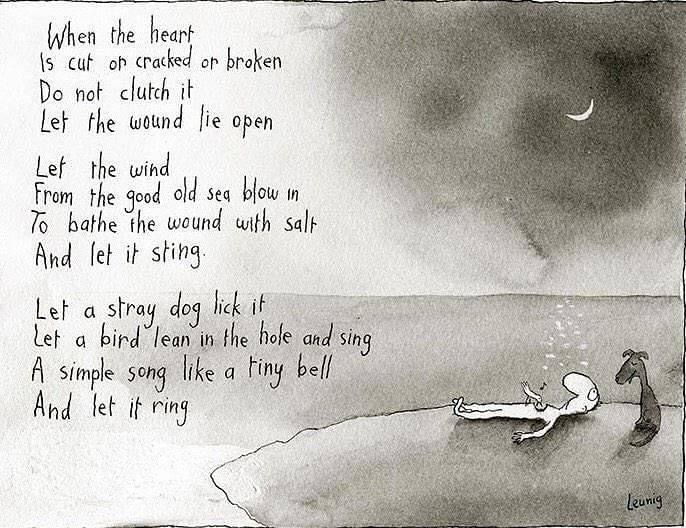
Don’t be alarmed. Proclaim the good news. Do not worry.
Destruction doesn’t get the final word. Resurrection is on its way. Amen.
 Holy Adventures