Apocalypse Sunday

Daniel 12:1-3         Hebrews 10:11-14,19-25          Mark 13:1-11

The 16th Century church reformer Martin Luther once approached this passage, relying on the promise at the end, ‘do not worry beforehand about what you are to say; but say whatever is given you at that time’. He is said to have ascended into the pulpit without a single thing written and asked the Holy Spirit for the words to say, and he received this answer; Martin, you have not prepared.

So that scuppered that approach!

Last week we heard Jesus’ commentary on the widow, as she entered the temple, and dropped her last two coins in the treasury, before going home to die. They were demanded of her, presumably to fund the large stones and large buildings that are impressing the disciples so much in today’s passage.

‘Look at them’, they say! And Jesus says ‘do you see these great buildings? Not one stone will be left here upon another; all will be thrown down’. And he continues later, in private, with the closest of his friends, with his apocalyptic discourse.

This Sunday in the church year is always Apocalypse Sunday, before we reach Christ the King next week, and then move headlong into advent. We always hear about the so-called ‘end times’, just before we move into the promise of the dawn of the new era where Christ reigns and the upside-down kingdom of love is ushered in.

But this week The Anglican Church had something of its own apocalypse when Archbishop Justin Welby announced his resignation after the results of the Makin report were published.

The report exposed the failings of the church to protect and respond to vulnerable boys who had been systematically abused in the most horrendous ways; including physically and sexually. The archbishop had become aware of this and informed the police in 2013, but action was not taken and the abuse was allowed to continue, was even silenced and covered up, until the death of the perpetrator in 2018, and even beyond. Archbishop Justin’s statement said he ‘must take personal and institutional responsibility for the long and retraumatising period between 2013 and 2024’. And even this week more and more boys, now men, are coming forwards and their pain is palpable and the archbishop’s resignation is not the comfort they hoped for.

And while all this was unfolding in the world’s media, these bible verses were waiting to be proclaimed in churches across the Anglican communion, worldwide, today. Social media was full of cries for his resignation and then sadness at the same. One priest friend wrote ‘you can take a brick from the top layer of a jenga game and nothing changes’, but it felt more like someone had pulled the brick from the bottom.

But Justin Welby is just one stone amidst the living stones of God’s Holy Temple, the Church – and so are we. So, this passage calls for something far more radical than the resignation of one man, even if it is the Archbishop of Canterbury.

Here, in the first century, Jesus predicts the destruction of the temple that indeed came to pass but is it also true that there are times in history when the whole temple of God needs a total breakdown, a total rebuild, and if God were to do that with God’s church here and now in the twenty first century, what might be rebuilt in its place? What would be kept and what would be broken and remade into something new?

And more pertinently, if God were to destroy and rebuild the temple of our hearts, what would be lost, what would be refined, what would be cherished, what would be encouraged to grow in its place? Big questions!

How would God reshape and remake the Church, universal?

How would God reshape and remake our heart? Your heart?

The disciples ask Christ for a sign – how will we know that all these things are about to be accomplished and his response is detailed; beware no one leads you astray, people will say all kinds of things but don’t be alarmed. He speaks of wars and earthquakes and famines, and he talks about birth pangs, about labour.

Wars, earthquakes, persecution, and this is only the beginning?! Destruction and rebuilding sound painful.  And for any of us who have been through a church split, or a marriage breakup or bereavement or any other kind of deep dismantling and rebuilding then we know that it is painful. It can even feel like we might just die.

But in our gospel reading today, Jesus has wise words for his followers – in these few verses he tells his friends, he tells us, beware…don’t be alarmed…proclaim the good news…do not worry. Those words promise beauty for the brokenness of the temple, hope for the brokenness that springs from historic abuse, or broken promises, or deep deep grief.

Don’t be alarmed. Proclaim the good news. Do not worry.

And that feels like wise advice for today, just as it was for those first century disciples too. It’s going to get bad. Maybe it already is bad. But don’t worry. You might feel like you’re even in the middle of death but resurrection is on its way. That’s always the promise, isn’t it. even in the deepest, darkest place of death, resurrection will still win. Destruction doesn’t get the last word. Redemption does. Do not worry.

And then, as if to reassure us that everything would be ok, the current day prophet Leunig popped up on my news feed with these words of wisdom too:
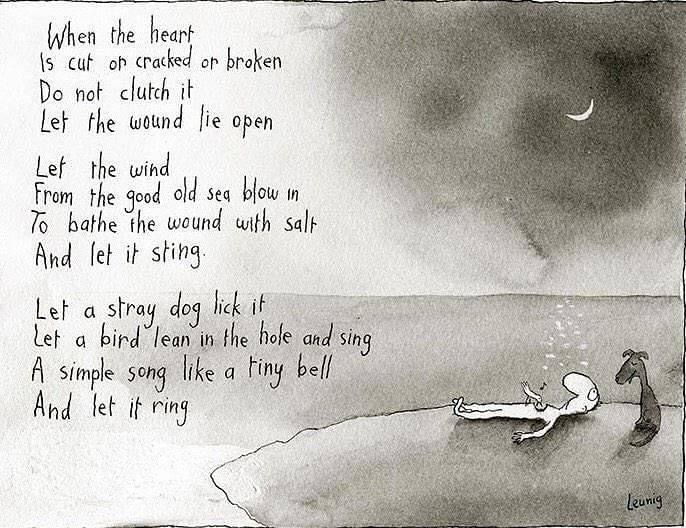
Don’t be alarmed. Proclaim the good news. Do not worry.

Destruction doesn’t get the final word. Resurrection is on its way. Amen.

A new look at the Widow’s Mite…

1 Kings 17:8-16       Psalm 146                Hebrews 9:23-28   Mark 12:38-44

How often do we genuinely approach scripture as if for the first time?

Usually we scan a passage, recognise the key figures, and assume we know the moral of the story – just as I did this week. Ah, the widow’s mite. We know the message of this one; loving and serving God demands my soul, my life, my all. Give everything. And then, something happens – something as seismic as the election of a president, and something as minor as reading a commentary from decades ago – and suddenly, the passage takes on a new message that is so ‘other’ to what I was previously taught, so opposite from what I previously believed, even what I preached before, that it stops you in your tracks.

I thought I knew this passage – Jesus and his disciples are watching the worshippers going into the temple. Some swan around in their wealth and riches and cascade their coins into the treasury. Jesus is not pleased with them. The widow brings her two copper coins and is highly commended for giving all she has. But is that what happens? I don’t think it is.

For sure, Jesus is very clear of his condemnation of the scribes – ‘beware’, he says, ‘they devour widow’s houses for the sake of appearance… they will receive the greater condemnation’. But does he commend the actions of the widow? ‘She, out of her poverty has put in everything…she had to live on’. It’s an observation, not necessarily a commendation. And when we read it alongside the verses from our other readings, they shed useful light on it too…

In our Old Testament reading we meet another widow. We hear her say, ‘I have only a handful of meal in a jar…I am going home to prepare it for myself and my son that we may eat it and die’ and Elijah tells her she will not die but will be cared for by the Lord until the rains come.

And our psalm is clear too: ‘the Lord executes justice for the oppressed…gives food to the hungry…lifts up those who are bowed down…watches over the strangers…[and] upholds the orphan and widow’.

God’s opinion of the poor and the widow is abundantly clear. God’s directive for how these groups of people should be cared for is unquestionable; care, lift up, give, watch over.

So, a new reading of this gospel passage might decry the systems that command this poor widow to give her last two coins before she can enter the temple. It condemns the rules that say only the rich can enter. It disrupts the processes that keep the rich at the front, relegate the poor to the back whilst taking their last coins so all they can do is go home to die.

The Lord of Heaven and Earth is very clear. Poverty is avoidable. It should not be a terminal illness. And we, as the world’s rich, are the medication to heal it. The world’s rich, are God’s solution to ending poverty and oppression.

So how have we got this so wrong?

How are we those who perpetuate poverty, even perpetrate it.

And while I haven’t made a complete u-turn from my deepest belief that following Jesus does mean giving up my own rights, my own comfort, even my own wealth – that still remains true – I am beginning to hear, in this gospel passage, that sometimes following Jesus looks like being the one who makes sure the widow has enough to live on, rather than demanding she give her last coin to the treasury. It has become a cry to see the systems that keep the poor as poor as possible – even to the point where they must donate their last coin to the wealthy, and go home to die. In the economy of God, we cannot be those people. We must not build or maintain those systems and, if we look ahead to next Sunday’s readings, Jesus continues this message and talks about the destruction of those systems.

But we are here in this week, in this place in history, where more than 74 million people voted to be led by a man who makes promises for mass deportation of immigrants, whilst giving tax breaks for the top wage earners; whose policies end diversity, equity and inclusion programs, while denying climate change and increasing drilling for fossil fuels which, of course, has a catastrophic impact on the world’s poorest first. He will restrict education for those who are poorest and only permit medical aid for those who work. He will keep the rich rich, and take the last two copper coins from the world’s poorest before sending them home to die. And I am sorry if mixing politics and religion is not palatable but these choices, this behaviour, is not what is asked of us when we sign up to follow the prince of peace.

We are asked to put more coins into the hands of those who think they are on their way home to die…and give them the promise of life. And we are asked to dismantle the systems that make them believe they must give that last coin in the first place.

This precious widow in our gospel reading did not need to give money before she was acceptable to God and beloved in God’s sight. And if she did die of poverty, then surely, she is one of the most glorious saints in light. As I say, so many times, there is enough wealth in this world for everyone – enough and some to share. What we need is an equitable sharing of it, and a bringing down of those systems that exist to line the pockets of the fat cats and starve the poor to death.

Every three years in the Anglican church we get the same readings from scripture. This time around the widow and Jesus are calling loudly to me to care for the poor, raise up the downtrodden, call out the systems of oppression – even destroy them. And because that is such a scriptural imperative, I think they always were.

Give us ears to listen, eyes to see, wealth and willingness to make change and voices to speak out for those who are kept silent. Amen.

All Saints and All Souls

Isaiah 25:6-9          Psalm 24            Revelation 21:1-6a           John 11:32-44

(Today we celebrate All Saints Day and remember All Souls; the souls of those we have loved and lost and who are now counted among the saints in light).

For someone who was brought up conservatively Baptist, I have a surprising devotion to the saints. I love the big hitters, particularly blessed Mary and Mary Magdalene, but they are merely the beginning of my saintly interest. When the Church went online for those long months of COVID our dispersed virtual congregation accidentally formed a new worshipping community under the watchful eyes of Ss Isidore and Carlo; the patron saints of the computer, and the internet. And this week I discovered the delight that is St Drogo – the patron of coffee, insanity and unattractive people and uncovered the irony that it’s St Gemma who’s the saint of all things back pain related. Who knew?!

And while we might petition St Anthony when we lose something, I am more interested today in the quieter, less famous, more under-stated saints that are around us, both living and departed, every day – because today is ALL Saint’s day, not SOME saints day.

Today we pause, breathe deeply, and seek comfort in the assurances of our Old Testament reading, that tells us there are those now feasting with the Lord at a lavish banquet. We hold tight to the promise that death will be swallowed up forever; there will be no more tears, no disgrace, no more waiting – just rejoicing and gladness.

Today we wait, together, for the day when we and our loved ones will be reunited, with God, in the new heaven and the new earth; where God will fully dwell with all humanity – our tears will be wiped away, mourning and pain will be no more, and all things will be made new.

Today we collectively gather at the universal tomb of death as we eagerly wait for Jesus to come and weep with us, take away the stone, and call life to ‘come out’ again.

We gather in this liminal space where we know death and grief – where, for some, this is the first All Saints Day where our favourite human saint is at the eternal banquet instead of eating with us – we gather here where our memories of our loved ones cause anxiety because we can no longer remember what their voice sounds like, we can no longer hear their laugh or smell their scent. And we gather here, taking our place in the line of the Saints – holding the baton that is ours to run with at this time, until it is time to hand it over.

And as we gather to honour those who have allowed the light of Christ to stream through them and warm our own faces, so we recognise that we each have a role in allowing ourselves to be used as saints – light bearers – on the journey of life for another.

You see, we are all saints. We are all forgiven, redeemed, made holy, given grace. There are those who came before us – great champions of the faith, stretching right back to the dawn of time – and there are undoubtedly those who will come after us. And here we are, right now, with our own part to play, trying to spot the saintliness in one another. Sometimes our light is tarnished, sometimes it is easier to spot. Sometimes we mar the image of the creator as it seeks to stream out of us. Sometimes we look at another and it is like we look directly into the face of Christ.

Last year I told you my favourite All Saints story, about the little girl wandering through a church, looking at the imagery of saints in the stained-glass window, before saying to her mummy, ‘now I understand! A saint is the one the light shines through’. Absolutely.

A saint is the one the light shines through. And one of the reasons we miss those who have gone before us is because the light that shone through them was fascinating and beautiful and life-giving and beguiling. Our call, as baptised children of God is to be that light for others or, as our gospel reading puts it, to follow Jesus’ invitation and command to be – like Lazarus – unbound, so the light might stream out of us, unhindered, undistorted, too.

We have a lifetime to do this, a lifetime to make an impact, and forever to be missed – like those we remember today. We grow into saints throughout our earthly lives, every day, ready to receive the crown when we reach the eternal banquet. And this is a lot to take in – a lot to process.

Today, we allow ourselves the time in this sacred place to recall the souls of all the saints; living and departed. We allow ourselves the capacity to be surprised by feelings that come unexpectedly to the surface and we sit with them, hold them, maybe light a candle for them and allow them to float upwards and outwards towards God.

We take a pause to allow the Christ to do that next bit of work in unbinding us, so that God’s Light might beam more brightly through us and, as God does God’s gentle work of grace in all these feelings, we simply breathe, say yes, and allow it to happen. So let us pray…

Time to speak out!

Jeremiah 31:7-9   Psalm 126   Hebrews 7:21-28             Mark 10:46-52

Last week I led a session at Wollaston Theological College, for those training for ordination. I had one hour to talk about the role of the church in the world. A whole hour! I began with my favourite question – one you will almost certainly have heard me ask before. I asked them ‘what is the one thing you would stand up in court for, go to prison for, even die for?’ And we took time to consider that, and to explore what the role of the Church might be in these situations. And we talked about immigration and poverty and injustice, but then, as I read this week’s readings, I realise what we were really discussing was what it is we refuse to stay silent about. What is the thing that breaks our silence and makes us speak out?

Human trafficking, child sexual abuse, the environment, homelessness, addiction, education, lack of access to services, loneliness, care for the sick and elderly. What are the issues, what will we do, what should the church – God’s people collectively – do?

Often, the focus of the story of Bartimaeus is the miracle of the restoration of his sight. And that is remarkable. Miraculous. But that isn’t the thing that caught my attention most this week. It was all the noise!

In the Old Testament reading we have people singing aloud, raising shouts, proclaiming (you can’t do that quietly), giving praise, and weeping. In our Psalm there is laughter and shouts of joy and then we meet the blind man, sat on the roadside. Or rather, we walk past the blind man on the side of the road. Totally pass him by and don’t notice him at all and Blind Bartimaeus begins to shout out, ‘Jesus, son of David, have mercy on me’! Many order him to be quiet – but this is the thing he will break his silence over, and he cries out even more loudly, ‘Son of David, have mercy on me!’

The crowds are moving, the people are noisy and the voice that rings out above it all asks for mercy. People try to shut him up and Jesus stops. He stands still and he says, ‘call him here’ and they do.

The blind man refuses to stay silent when he knows his healing is available to him. He refuses to keep quiet, regardless of custom or tradition or respect. He cries out his own protest shout. And while we reflect on him breaking his silence, I wonder again what I might break my silence over. What is your Bartimaeus moment? When will we find ourselves standing alongside our own Bartimaeus and speak out for the sake of that man. What is it that will do away with our excuses of being too shy, not brave enough, not educated enough? What will open our hearts enough so our voices will follow?

And that leads me to ask the question, what will the church – worldwide – refuse to stay silent over? What loud calling voice do we need to hear from the church in the world, right now?

This past week I received an email from an organisation called ‘Palestinian Christians in Australia’, asking for the church in Australia to speak out against the genocide in Palestine. They wrote,

This past weekend, we commemorated one year since the Church of St. Porphyrios was hit by an Israeli airstrike, killing 22 and injuring 18 members of our community. Hundreds of Palestinian Christians remained sheltering [in churches] in Gaza. They have been there since October 2023, with nowhere to escape. Close to 200 have valid visitor visas for Australia. But the Australian government has not adequately supported them to leave Gaza, and now their visas are due to expire.

We are inviting Christian leaders around Australia to advocate with and for us. 

In direct response to this advocacy, the government has pledged just over $477,000 to Palestinian Christians in Australia to house families arriving from Gaza. We are thankful for God’s faithfulness, the Church’s support, and the government’s provision… But thousands of the Australia Palestinian community’s family members remain trapped in Gaza, suffering famine, destruction and bloodshed. We are calling for the Australian Church to join us once again, as we say, more must be done. 

We are inviting you to join the coalition of Christian leaders, as we call on the government to:

  1. Grant emergency humanitarian visas to thousands of Palestinians in Gaza.
  2. Provide sustained diplomatic pressure on the Israeli government about border crossings to allow safe evacuation from Gaza
  3. Provide assistance once these families arrive in Australia.

We are looking for churches to endorse the campaign…

And that makes me want to stand, like Bartimaeus did, and cry Lord Jesus, Son of David, have mercy on us…

Last week, I preached that sometimes we need to say yes to God and then stay silent. And that remains true. It is also true that sometimes we need to say more – not just in prayer, but in word and action, in letters, in protests, in court or parliament, online and in person. Sometimes we don’t have the luxury of remaining silent. Sometimes speaking out leads to healing and freedom. Sometimes speaking up shines the light on that which is wrong and brings about change.

The words of the collect at the start of the service captured it beautifully when we prayed, ‘Jesus Christ…you heard the cry of the blind beggar when others would have silenced him. Teach us to be attentive to the voices others ignore, that we might respond and heal and welcome, for the sake of the gospel.’

So, in a few moments of silent reflection, let’s consider the question I began with; ‘What is the thing that will break your silence and makes you speak out’. There are those who are waiting for your voice. Amen.

Meditation for Good Friday

I woke up early, in that half-light, struggling to orientate myself, trying to figure out where I was, for a moment not feeling the fear and anxiety and then it hit me again in another almighty wave. This cold stone cell, these chains, and that hollow empty feeling, like hunger, but filling my whole soul, seeping into my bones. Will today be the day I die?

Tensions have been rising around the jail. A new convict was brought in through the night. What a stir.

Dead man walking.

People jeering, soldiers mocking, high priest questioning. And as the cock crowed the sentence was passed – criminal charged, crucify him.

I do not know the man, but some were shouting King.

Some shouted King, but the louder cry was crucify.

His fate, the same as mine.

But is today the Passover? Someone is released at Passover – maybe today is my day after all. Maybe today will be a Good Friday. Maybe today I will live?

Convicts are assembled, dragged together into line, paraded before the crowd, baying for blood. How should I stand, what will best appeal to those who hold my fate right there in their mouths? Should I look them in the eye, or look down in regret? Can I show an apology? Am I sorry? And what is that current running through my bloodstream? Hope?

Do you want me to release for you the King of the Jews??

Not this man.

Not this new convict, this silent, whipped, beaten and bruised criminal.

I don’t get a look in – nobody is considering me for parole.

Release Barabbas!

Barabbas?! He’s a terrorist – a violent murderer.

I’m not like that guy. I’m a rebel, not a killer. And they are releasing him?! He gets his freedom?? They didn’t even see me standing there, condemned.

So our fate is sealed. We will die, today. And I will be alongside this one they mock as king.

I chance a look at him. He is just staring, but there is something in that broken face, something behind those swollen eyes. No, I can’t place it. Peace? Surely not. Must be pain, acceptance, maybe he’s able to dissociate. Maybe he’s not here at all.

But then the whip is cracked and we are present. The crowd screams in unison and we are forced into line.

Bones exposed, skin raw, muscles wasted, hunger won, battle lost and we are presented with a cross. A crude, splintered, heavy wooden cross. Our weapon of torture. Our place of death. This king’s throne.

‘Carry it’ they shout, and we stumble under the weight.

Walk, trip, fall, whip, snap, weep, walk – all the way to the place of the skull.

The walk is interminable but arriving feels worse.

It feels like it will take forever to get there, but unfortunately it wont. We’ll be there soon enough. We will be gone soon enough.

With every step I think of those I love and those I have hurt. One list long, one pitifully short. I deserve to be here. These steps, this cross, this hill, this death – it’s the way the road goes for people like me.

The crowds line the streets – they said they would.

People spit, others cry.

The king falls and falls again. Someone else carries his cross. And his mum is there too. It looks like her own heart is pierced, just as our hands and feet will soon be.

My head spins, blood gurgles in my throat and blurs my eyes.

My ears are muffled to the sound of the crowd and all they hear is the thud of my heart. How many more times will it beat, before it stops, for good?

And then we arrive. The cross hits the ground, we are thrown on top and the guards pin us down, tie us down and then drive the nails into our wrists and feet.

I’m sure I black out. I feel it. I can’t feel it. My mouth is dry and my limbs are burning.

I feel a rush of air as the cross is raised, and pain like I’ve never felt before excrutiates through me as it, as I am dropped into the stand. The place I will die.

Again, I black out, I come round.

The crowd blurred below, the soldiers gambling and laughing – fighting over something, spitting and drinking.

I try to move my head and I see the man beside me, and the one beside him.

I thought he was pleading – get us down from here – but he’s mocking – get us down if you can, King.

He calls him Jesus.

This is Jesus?

The prophet? Messiah? The son of God? I’m dying beside the Christ?!

And I don’t know what happens, but I find a voice. I tell him to shut up – we deserve this and he’s making things worse. We are in the presence of royalty, in the presence of divinity and holiness. He must know what I have done and yet all he says is ‘father forgive’ and ‘I thirst’.

What do I have to lose? These are my last breaths, my last minutes. What can I lose? What can I gain?

I manage to swallow – a mix of blood, sweat and saliva – and in one breath I force out ‘Jesus remember me when you come into your kingdom’

My mind is cloudy but my thought is crystal clear. In that moment I knew it.

That forgiveness was for me. 

That thirst is for righteousness, holiness, freedom.

He will drink in another kingdom, and I want to be there.

He looks at me and there is something like a smile, something like love, and he says, through split, dry, lips ‘today, you will be with me in paradise’.

Today? This day, that began with the promise of sure and certain death?

This day of torture, shame, mockery and pain.

Today, paradise.

What dawned in the depths of darkness is setting into a truly Good Friday.

We wish to see Jesus

Jeremiah 31:31-34       Psalm 119:9-16       Hebrews 5:5-14    John 12:20-33

I have a question for you: Why do you come to church? (You might be sat there wondering the same thing!) But genuinely, why do you come to church?

Our community is pretty fabulous, the coffee is fresh, there is often champagne, the choir always sounds great, sometimes even the preaching is ok. But what is it that draws you back, week after week? Or what brought you back after that long spell you had away from church? I’ve been thinking about it, and I have to believe that, as with the Greeks in this morning’s gospel passage, the bottom line about why we each come, is that we want to see Jesus.

You see, there are nicer people, better coffee, colder champagne, greater music and yes even better sermons, elsewhere, but the reason we come here – I might even dare to say, whether we realise it or not – is because something inside us is captivated, drawn, intrigued enough by the notion of God that we come along because we want to see more, maybe even touch, hold or taste more. Like those first century seekers, we want to see Jesus.

On Tuesday night I went to a different church for a meeting. I didn’t realise I was going because I wanted to see Jesus. I thought I was going because it was in my diary. But there I met this woman called Asuntha. Asuntha Charles is the National Director of World Vision in Afghanistan.

Born in a village in southern India, Asuntha was the last daughter in a family of six. There was no reason for her to go to school and every reason for her to be married. But Asuntha was born to a feisty mama who, whenever Asuntha asked ‘can i…’, replied with ‘let her have a go’.

Asuntha completed school and university and became a social worker, always seeking out women and children in the world’s poorest corners. More recently her work has taken her to Afghanistan. When Taliban rule began, humanitarian agencies were encouraged to pull out, but this tiny, brave, single woman refused to leave. She showed us photos of 5 year old girls she had rescued from the marriage they were being sold into, with men nearing retirement age. And she told us that she will work with girl children in that broken place until one of them becomes president.

I thought I was going to a meeting. I was. And in it, I saw Jesus.

Sir, we wish to see Jesus. Well, go and hear Asuntha. Go and see what people do in my name, he says.

The next day I went to share holy communion in an elderly care facility and I read them this bible passage and I told them how I had seen Jesus the night before, in the words and face of Asuntha. And then Janet spoke.

Four months ago she was given three months to live. But Janet knits. And she has a deal with her Lord that so long as there is wool, she will keep knitting. When the wool runs out, she will go home, she says. She is midway through her recent cancer treatment and feels rotten but wool keeps appearing in her room and she often has no idea how it got there. So, she addressed the group, saying, ‘I knit. I knit beanies and mittens and socks for prem babies. And sometimes, when I knit, a little teddy pops out and I give that to the babies too. And I do that as a reminder that Jesus loves them’. And she was not in the least surprised when I said I could see Jesus in her. She can see him too.

Sir, we wish to see Jesus.

Well, he is appearing in knitted bears and beanie hats in prem baby wards of Perth’s hospitals. You will see him there.

And we come here with that same request – we wish to see Jesus.

And we might glimpse him in the scripture, or hear him in the melody of the hymns, we may hold him in our hands; eat and drink him in the mass, and at the end of the service I will send you on your way with these words; ‘May you see the face of Christ in everyone you meet, and may everyone you meet see the face of Christ in you’.

Sir, we wish to see Jesus – he is right here – around you and within.

Or, to use St Patrick’s words, whose feast day we remember today;

Christ is with you, Christ before you, Christ behind you, Christ in you,

Christ beneath you, Christ above you, Christ on your right, Christ on your left,

Christ when you lie down, Christ when you sit down, Christ when you arise,

Christ in the heart of every one who thinks of you,

Christ in the mouth of everyone who speaks of you,

Christ in every eye that sees you, Christ in every ear that hears you.

You wish to see Jesus?

He is right here.

Let us pray:

God. We wish to see Jesus.  Show us where we might find him.

Open our eyes, unclog our ears to hear him, make us attuned to where Jesus shows up.  Show us Jesus in the changing of the seasons; in the warmth of the sun and the cool of the clouds.

Share Jesus with us in waves on the beach that are made of the same water that lapped on the shore when he roasted fish with his disciples after the first Easter. 

Show us Jesus in those we look up to and respect. 

Show us Jesus in those who serve others, in those who bring new life into this world, and in those who care for us after death. 

God, show us Jesus in the places and people we don’t want to see Jesus in. 

Remind us that they share a spark of the eternal life of Christ, even if we might not see it, even if they might not see it. 

Show us Jesus in a world that doesn’t look like the one Jesus proclaimed and show us Jesus calling us to make that world a reality. 

God, we wish to see Jesus. 

We want our eyes and ears and hearts to be open.  God, refresh us with Jesus. 

Amen. 

Turning Tables

Exodus 20:1-17        Psalm 19     1 Corinthians 1:18-25         John 2:13-22

At community breakfast yesterday I was treated to some of the more colourful stories from the life of St Paul’s. Like the time someone came right up to the altar, rummaged in the offertory plate, and helped himself to a few fifties and twenties before running off with them. Or the time someone put their hand up towards the end of a service and confessed, before God and the congregation, that they had taken and drank every last drop of the communion wine.

And that made me wonder, how the people in the temple recounted the story of Jesus’ actions that we just heard.

The Passover of the Jews was near, and Jesus went into the temple and found people selling cattle, sheep, and doves, and the moneychangers seated at their tables. He made a whip of cords and drove all of them out of the temple, including the animals. He poured out the coins of the moneychangers and overturned their tables. And then he told them, “Take these things out of here! Stop making my Father’s house a marketplace!”

It would’ve been one of the more memorable days at the temple. Surely it would’ve been talked about for generations! Just like those stories from the past years of this place.

So, on three different occasions this week, different people told me about the man who stole from the offertory plate. And in each retelling, the speaker knew that if that man had only asked for money here, it would’ve been given to him. That this is a place of giving, of provision, a place where those in need can come for help.

And what I heard in the tale of the person who took and drank the communion wine is that this is a place where we can ‘fess up to things we have done wrong. It is a place we can come as we are and say ‘yeah, I messed up’ and we will still be accepted, and find forgiveness. And it’s also a place where everyone is welcome to eat and drink our holy meal – all are welcome. You don’t need to sneak in and steal it, just come hungry and thirsty and hold your hands out and it is yours. And there’s nothing you can do to be more worthy and nothing will prevent you from being able to receive.

So when the temple goers and the disciples left the temple that day and recounted the story, what would they have said?

First, Jesus was really cross. Take these things out of here, as he cracked his newly made whip. And he overturned the tables and scattered the money everywhere. Stop turning my father’s house into a marketplace.  But the thing is, the temple system ran on a marketplace sort of principle. You had to have money changers so worshippers could change regular cash into temple coins. And you had to have animals for sale so people could buy what they needed for their sacrifices. That was how it worked. So this outburst, this anger, ran way deeper. He wasn’t just clearing out the traders – he was clearing out the whole temple system. He wasn’t just overturning the seller’s tables – he was overturning the way things had been done for generations. He was flipping systems.  He was changing everything forever.

In that act, Jesus is saying there is no longer those who are in and those who are out. There is no longer those who can afford to worship and those who are too poor. There is no longer a case where the rich and/or corrupt govern this place. It is not based on a financial interaction, nor on animal sacrifices. This is a new era. This is my father’s house – it is his home – he decides who comes in, and all are welcome here.

I don’t want your money. I don’t want you to buy me a sacrifice. I don’t want spilt blood. I simply want you – all of you – body, mind, soul, spirit, all you have and all you are, all you own and all you lack. I want it all.

And as it was then, so it is now.

There are no rules, no systems, in place that can or will stop anyone from coming to Christ – except for those that we might put in the way. And every time we block or stop others from coming into God’s presence, Jesus is right there ready to knock that over and turn it upside down and clear it out. And that is as true in this place as it is in the temple of our hearts.

You see, we come together in this place, in this temple, and Christ constantly waits to welcome us, and Christ constantly waits to challenge us to remove any blockages we have here.

But we are also walking, talking, living, breathing temples of God’s spirit. And I wonder what God might be eagerly waiting to clear out from within us too.

What blocks, what systems, what beliefs, what restrictions do I have in my own heart that prevent true worship from being able to take place there? What hurt, what self-doubt, what utter independence or pain am I storing up in my heart that needs clearing, yes even with a whip of cords.

Jesus walked right into that temple in Jerusalem and did the clearing, uninvited. I hope he will walk right in here too and clear anything that offends him or blocks out others. This is God’s place, God’s house, and God doesn’t need an invitation to be here.

But when it comes to the temple of our heart, Christ won’t barge in. He waits for an invitation. We can choose to hold onto and perpetuate those systems that keep God out. We can set for ourselves rules and regulations that we must reach, and then fail to reach. And Christ is always waiting to dismantle them.

So, in the stillness and the silence will we whisper our invitation for him to come in and clear out, that our worship may be pure, unblocked, expansive, inclusive, and wholehearted, because that is the worship that is acceptable in God’s sight. Amen.

What if you fly?

Genesis 17:1-7,15-16     Psalm 22:24-32    Romans 4:13-25  Mark 8:31-38

It’s rare to remember the full contents of a sermon, isn’t it?  I can probably remember around 4 great sermons in my life – the one that brought me back to faith in 2001, the time I heard this hot guy preach in 2005 – that was a real blinder – so much so, I went on to marry him! And there have been a couple of others, but they are few and far between. But it just so happens one of my all-time favourites was a sermon I heard on this morning’s gospel passage while I was sat in the Los Angeles sunshine, in an outdoor church, in a parking lot, that had been turned into a garden. A Garden Church. And it was 2017.  My dear friend Revd Asher only spoke for 5 minutes, and he blew this gospel apart.

Asher is transgender and was born in a female body. He spoke about his teenage self, walking into a doctor’s surgery during his transition journey. The doctor invited that teenager to bring a few items that characterised them. In that box were photos of Mary – the name Asher was given at birth – they recalled the time she was bridesmaid, there were notes and trinkets and other things she held dear. And the doctor asked Mary if she was prepared to close that box and die, in order that Asher might live.

And Asher had a really important decision to make; Asher said, ‘I had to decide, was I prepared to give up what I believed to be life and do something really bold in order to gain what truly is life’. Asher, or Mary, was being invited to die in order to truly experience what is life. And in this morning’s gospel passage we are invited to do just that too.

If any want to become my followers, let them deny themselves, take up their cross and follow me.  For those who want to save their life will lose it and those who lose their life for my sake will find it.

In this invitation, I picture Jesus standing on the edge of a huge mountain, gazing over the precipice.  So here we are, Jesus says: if you want to follow me, you need to let go of all this…let go of what you believe to be life, do something really bold, and then you will truly gain what is life.

Erin Hanson, a young Australian poet, captures something similar to this in her beautiful words where she writes, ‘There is freedom waiting for you, on the breezes of the sky. And you ask, “What if I fall?” Oh, but my darling, “What if you fly?’

Every single day, we get this invitation from Jesus Christ; there is freedom waiting, and it looks a bit different than you might expect because it involves being prepared to leave everything behind, even yourself, take up your cross and follow me, Jesus says. And yes, you might fall, but oh my darling, what if you fly – yes you will lose your life, but my darling, you will gain it. You will save it.

What an invitation – to give up the ordinary for something extraordinary. What an offer – and it’s definitely an offer, not a demand. If you want to become my followers. If you want to. You get to choose.  And you can choose to say no. God won’t love you any less but oh my darling, then you might never fly. You might never gain that extraordinary life.

And what a day to be reminded of this because today we are celebrating baby June’s baptism. I once read a fabulous book about baptism where it memorably said ‘baptism is the sacrament in which we die’. That’s not something we often say, because it’s not that palatable for the parents, or their friends and family. But symbolically, in the waters of baptism we say yes to that glorious invitation from Jesus and that means saying no to doing things are own way. We are saying we will take the hand of Christ, step off from this ordinary life and believe we will fly. We are committing, each of us who are baptised, and teeny baby June today – we are committing to live our life Christ’s way, not ours – or rather, to deny ourselves and follow him. And because June is only 4 months old, her parents and Godparents will say yes to that eternal invitation on her behalf, and we will promise to help them to fulfil it, until she is able to stand before God and a Bishop and make those promises for herself.

In our invitation from Jesus, there is always something we will need to leave behind.   Asher had to leave behind Mary. He had to do something bold to lose what he had believed to be life, in order to gain what truly has turned out to be life; a life laid down in worship and service of Christ’s church as the priest of God that Asher now is.

And just as Christ invited Asher to live his own extraordinary life, so Christ is inviting us, so Christ is inviting you.

What might you need to leave behind?

What do you need to let go of so you can take hold of new life with both hands?

Today Jesus is inviting baby June to the waters of baptism and every day he is inviting us to step out, leap off, from our ordinary existence into something completely extraordinary.

What if you fall? Oh my darling, but what if you fly. Amen.

Lent One – 2024

Genesis 9:8-17      Psalm 25:1-10       1 Peter 3:18-22      Mark 1:9-15

We hear the story of Jesus in the Wilderness on the first Sunday of Lent, every year, so it may sound familiar. Satan tempts Jesus in every way and yet he doesn’t succumb. And often the teaching is that Jesus has gone there before us and because he managed to not give in, and we should try to do the same. In Mark’s account, the whole scene takes only two verses.

‘The Spirit immediately drove him out into the wilderness. 13He was in the wilderness forty days, tempted by Satan; and he was with the wild beasts; and the angels waited on him.’

Mark speaks fast. He talks really quickly and very dynamically.

Everything happens suddenly, or immediately. His whole gospel is at breakneck speed but – even so – forty days in fewer than forty words is still some going. And we hear it every year, but because of Mark’s brevity, we might more easily notice the events either side of the wilderness story.

So. [hand actions] Jesus comes from Nazareth…

Goes down into the water…

Comes up out of the water…

The spirit comes down from the heavens…

And then Jesus is driven into the wilderness.

That’s a lot of movement. A lot of going down and coming up. And if we read those movement words in the original language we discover that the spirit descends in the exact same word as how the temple curtain was torn from top to bottom at the moment of the crucifixion – like, at the moment of Christ’s baptism, the veil between heaven and earth became separated, just as it did at the moment of his death.

And the spirit drove Jesus into the wilderness in the same way, with the same word, as Jesus drove out demons, AND in the same word as would be used to describe violent sickness – the Spirit vomited Jesus out into the wilderness; that same spirit that unzipped the divide between heaven and earth in her descent then convulsed Jesus into the wilderness. The same that spirit descended to proclaim God’s love and parenthood drove Jesus from that place of identity and holiness right into the firing line of the wild beasts.

Surely there must have been a purpose for that deliberate act. It wasn’t just a suggestion made to the dripping wet Messiah – it was a propulsion. And I guess that makes sense; there would be very few of us who would choose to wander into the wilderness, or into any other difficult or brutal situation. Maybe there was a purpose?

When I say ‘purpose’, please don’t hear me saying that God causes or chooses suffering for God’s children. I am not saying that. I don’t believe God allows suffering, just so we learn something, and certainly not as punishment. Let me make that clear. But I can believe that our God is one who accompanies and who redeems – that no situation is wasted – that nothing is so bad that God cannot bring good out of it – and that, despite how alone we might feel in the moment, God is always alongside us, and is always for us. If you hear nothing else today, please hear that.

So… Perhaps there was a purpose for Christ’s journey into the wilderness, because when we return to the passage, we discover what came next, or what the wilderness prepared Jesus for. He is spewed into the wilderness, where he spends 40 days and nights, and then he re-emerges with this message – it is the first thing Mark’s Jesus says and it is this: the time is fulfilled – the Kingdom of God has come near, repent and believe.

And where did he discover this? In the wilderness.

And that sounded like the most Jesus-thing I had ever heard.

In the darkest place, where there is nothing but brokenness and danger – that is where the Kingdom of God comes first. Of course it is! Isn’t it always that God shows up where we least expect it?  Isn’t it always in the darkest place where the light shines brightest? Of course, God’s Kingdom came near in the desert place of the wilderness, where Satan was prowling and the wild beasts were sniffing about. Of course it did. Of course it does!

When Jesus went into the wilderness, the veil between heaven and earth was the thinnest – the Spirit had torn it open in Her descent at his baptism. Heaven was closest, clearest, and the spirit sent him to the most barren place, to take his light there first. And only once Jesus had kicked a chasm into the darkness of the wilderness did he come to tell the others – now the kingdom of God is here. Now we can begin.

So, if you are wandering in the wilderness, even if you are just skirting around the edge, knowing it is near, hear this; you are not alone, you are not abandoned, you are in the place where the Kingdom of God will break in first, and you will be there to see it.

That is what the newly baptised, wilderness wanderer teaches us. And then our second reading reminded us of what the crucified Jesus did first; ‘he went and made a proclamation to the spirits in prison’, it said.  When the curtain was torn in two the next time, on the cross, at Jesus’ death, he went first to the spirits in prison – or rather, he went to the depths of hell and said ‘it is over’, light wins. Love wins. The kingdom of God has come near. Jesus always goes to the darkest place first. And if that is where you find yourself today, Jesus is on his way. The kingdom of God is coming near.

And for those of us who aren’t in the wilderness right now, we would do well, this lent, to make it our purpose to go to the darkest place we can find and take the light of Christ there. But don’t be surprised to find it there already, ahead of us, because it is always in the place of death and decay that our Lord is to be found first.  And it is there, in the bringing of light and hope, that the Kingdom of God comes near.

Repent and believe. Amen.