
Advent II – Year C

Malachi 3:1-14     Psalm: The Song of Zechariah (Luke 1:68-79)

Philippians 1:1-11           Luke 3:1-6

This week has been wild. With squashed banana and congealing yoghurt, and sticky fingers on every pane of glass, there isn’t much purifying going on in the rectory and if this sermon begins to go all singsong, like a nursery rhyme, then I’m sorry, but we’re upright, and that’s the best we can expect right now, right?!

Fortunately, this is one of my most favourite passages in the Hebrew scriptures, this prophesy from Malachi about the coming king. Hear it again…

See I am sending my messenger to prepare the way before me, and the Lord whom you seek will suddenly come to his temple… He is coming. But who can endure it?  For he is like a refiner’s fire.  He will sit as a refiner and purifier of silver.

Such rich imagery. What a clear picture. A refiner’s fire, a purifier of silver.

Several years ago, I investigated what it is that a silversmith does and, it was as I read that this passage rocketed up the list of favourite verses. Do you know how a silversmith refines metal?  Do you know how a goldsmith tests for purity?  Maybe I’ve told you before.

They sit, for long periods of time, holding the metal in very intense heat and they keep it there until the dross burns off and it is free from impurity.  They burn it to make it clean. And how do they know it is pure?  What is the test? It is only complete once they can see their own reflection in it.  The face of the one who creates it.

So, what does this prophecy say for God’s people?

The Lord is coming.

And in God’s coming is the promise that we will be held in God’s fire until all that is dross burns away, and until God sees us as pure, and as perfectly reflecting God’s own face.  We, and all God’s people, down through the ages, will be made perfect, so we can reflect the image of the Divine Silversmith – so people will look at us and see the Great Creator.

And as a gold or silversmith sits at their refining fire, are they concerned about the impurity? Do you think they spend time worrying about the dross and the grime? I bet they don’t. I expect they know that all that is precious is right there waiting to emerge, waiting to bubble to the surface. They simply hold that precious metal in the fire until their own face can be seen in it and then they know it is ready.

‘The Lord whom you seek will suddenly come to his Temple’, says Malachi.

He promised this to God’s people 400+ years before…and then there was silence… nothing.

God’s people, through the ages, knew they were waiting for The One to come to the temple, ready to refine and purify, and reflect the image of the creator. Maybe they would be the generation that would be chosen to next reflect the glory of God. Always watching, listening, waiting, hoping. But for centuries it all went quiet…

And then suddenly we get this crazy prophet bursting onto the scene. John; the last of the Old Testament prophets, cries out in the wilderness, ‘prepare the way of the Lord, make his paths straight. Every valley shall be made straight, and the rough ways made smooth, and all flesh shall see the salvation of God.

The time has come.

The time of purifying and refining, the holy burning, to remove the dross and reflect the Glory of the Divine…it is near.

Who can endure the day of his coming, and who can stand, Malachi’s prophesy asked. And I wonder what that is asking of us, here and now. Who can endure? Who can stand? Will we give in to the process of our creator, whatever it takes and wherever it takes us, so that we can be made pure – not sinless, not shiny clean, I don’t mean that – I mean truly pure so that, in the words of our gospel prophet a few decades hence, ‘we must decrease, and you must increase’.

God making us pure means seeing more of God in us. More of God and less of self, less of ego, less of our own good works and more of God’s work.

And that’s tricky, right, because we want to do those things that God asks of us, and sometimes we get in the way of God’s glory being seen, sometimes we might almost block out the light. So we must return again and again to the refining fire and hand ourselves over to the Divine Jeweller – make of me what you will, Great Creator – take my simple offering, my tasks, my hopes, my attempts, my heart and soul and burn off all that is impure and make it pure.

Handing ourselves over, even once, let alone over and again, sounds uncomfortable, risky even. Maybe that’s why the prophecy asks ‘who can endure and who can stand’. Knowing we are delivering ourselves into Hands, even the holiest of hands, where all that is purely-self is potentially painful. What if I like the bits that are burned away? What if I was particularly attached to them? But, it is the call of those who are seeking after God. It is the offer, the invitation, that we might be made refined and pure, that we might reflect God’s glory and not our own.

Uncomfortable, yes. But how liberating? Imagine the freedom of complete purity.

Yesterday Gabby posted another fabulous Gabby image on our Facebook page, with words from the Indigenous Leader, Steven Charleston. His poem ‘Wild Places’ perfectly span our two prophets for this morning – Malachi and John the Baptist. He writes this:

A voice crying in the wilderness.

The call of the Spirit does not come in quiet places of comfort.

It beckons us from wild places: that interior wilderness, just outside the walls of polite society.

The dark woods where we are afraid we may meet the stranger.

It is the risky land of encounter.

The invitation of the Spirit is to go out by going in.

To question what we know.

To encounter what we fear. 

We are purified not with drops of water but with beads of sweat.

Amen.
16 days of activism against gender-based violence

This homily was preached at St George’s Cathedral, Perth, on the eve of 16 Days of Activism Against Gender-Based Violence (24/11/24)

It was in the back room of a Cathedral like this, in another continent, that I attended a session called ‘Domestic Abuse and how the Church should respond’. Maybe a decade had passed since my first marriage ended, but in the words of our first reading, I was still ashamed, disgraced about it, and pretty discouraged about the way the church had handled it.

Battered from my marriage breakup and seeking some sort of familiarity and comfort – seeking God, although I didn’t know it at the time – I tiptoed back into the church of my youth. The church where I met my first husband and where we had married. The minister called me a scarlet woman and asked how I dared to walk into his church with my head held high. His wife – ironically the ‘welcomer’ on the door –refused to give me a notice sheet – she said there would be no need for me to know what was happening in church that week.

The requirements to be allowed back into the fold were clearly laid down to me; I would need to stand at the front and explain to the congregation why my marriage had ended, and repent. There were no similar requirements for my husband. No requirements at all. The minister knew nothing of the state of my marriage, nor the reasons for its breakdown. He never asked. And that added to my shame.

And yet, because God had breathed God’s promise into my heart that said ‘I’m pleased to hear from you Gemma, and I love you’, because God was proving again and again to be a trustworthy and redeeming husband who was not casting me off – ever – and had gathered me up and was beginning to whisper terrifying plans about ordination, I dared to wholeheartedly, even foolishly believe the church should have something to say about the things that break marriage, and people, and should be able to offer a way back.

And if the church should respond to divorce, then it must also be able to respond to issues of domestic abuse – those marriages that had been way worse than mine, because I had believed that mine was just a mismatch, a mutual falling out…and he had never hit me.

So, I sat in this training – domestic abuse and how the church should respond – and I felt empowered and hopeful and ready to become that Christian, even that Christian leader, that helped ‘those people’. Those poor women whose husbands beat them.

Mid-morning we began to look at different types of abuse. I can picture the piece of paper she handed out; there was a person in the middle with speech bubbles around her – emotional abuse, physical abuse, sexual abuse, financial abuse, and so on – and there were dot points under each, listing behaviours.

And as I stared at the page it began to swirl, and I filled in my own dot points;

  • that time he told me I looked like a cow because I was chewing gum,
  • the way he gave me pocket money – from my own wages – because he controlled the money;
  • when he told me which church we were moving to because he was the spiritual head of the house and I had promised to obey;
  • removing the pizza from me, so he could help me not get fat;
  • the clothes I was allowed to wear with him, but never with other men;
  • the time he told me, ‘close your mouth; you looked retarded’ when I was marvelling at the intricacy of dew on a sparkling new spider’s web;
  • the times he wanted sex and I didn’t, so he did it anyway
  • the day he finally raised his hand in anger, because I wanted chips

Shaken, I excused myself from the training and locked myself in the bathroom. I can still picture the inside of that bathroom door where I rested my forehead and wept, realising for the first time, 10 years after it was over, that I had been in an abusive marriage, and its breakdown wasn’t all my fault, despite what the divorce papers said.

The world taught me domestic abuse was only physical. That nothing else counted, nothing else was as bad.

The church taught me divorce is always the woman’s fault and always because she had an affair, so she wasn’t welcome, unless she publicly repented.

God taught me that wasn’t true; that I was beautiful and called and loved everlastingly. And that God is a trustworthy husband, and other men might be too.

I returned to that training session, red-eyed but resolute; determined I would face the trauma of what had been, would commit to healing from it, and would use all I was feeling, including my anger and pain, to strengthen me so I could support, challenge and help others. And that I would do my bit to make sure the church really could respond to domestic abuse, generously, courageously, without misogyny; being kind, tender hearted, forgiving, melting bitterness, giving grace.

In Australia, 1 in 4 women experience domestic abuse in their lifetime.

1 in 16 men.

Indigenous women are 33 times more likely to be hospitalised by FDV and 7 times more likely to be murdered by an intimate partner than non-indigenous women.

And these statistics are at least as high in Anglican churches, if not higher.

Friends, you may have heard it said that domestic abuse is only abuse if she is battered and bruised or raped.

You may have heard it said that the man is the head of the household and the head of his wife.

You may have heard it said that she deserved it or that Christian marriages are exempt or it doesn’t happen here or any number of other false statements about FDV in faith settings and homes.

But now we say to you, domestic abuse happens all around us, in our churches, our schools, our communities, even in our own homes. And the responsibility of shining the light of Christ on perpetrators and survivors alike is in our hands.

You may have heard it said that it’s not your business, not your job.

Now hear us say to you, yes, it is. Amen.

Another World is on its way…

Daniel 7:9-10,13-14        Psalm 93                 Revelation 1:4b-8           John 18:33-37

One of the most beautiful things I ever heard is from the Prize-Winning Author, Arundhati Roy, who wrote ‘another world is not only possible; she is on her way. On a quiet day, I can hear her breathing’. Isn’t that stunning?

Back in 2017, I accidentally landed up being part of an American cohort of preachers – I say accidentally, because I’m not American – and we were given funding to develop a project that preached resistance, through word and song. Preaching resistance, with gospel passages like this was a simple task and one of our group wrote a chant from that beautiful quote. You can see the words on page 6 in your service book and I’m going to step out of my comfort zone and teach it to you.

It goes like this:

Another world, another world is not just possible it’s on its way

And we sing that twice. Let’s try:

Another world, another world is not just possible it’s on its way

And then it goes…

And I can hear it breathing, and I can feel it coming

It’s not just possible, it’s on its way.

Let’s try that…

All week I have been singing it because it encapsulates what happens in these verses from John’s gospel.

A beaten and bloodied Jesus is before Pilate and is asked ‘what have you done?’.

And Jesus doesn’t answer the question.  Not specifically.  But he could.  He’s got a whole resume of things he’s done.  What have I done? I’ve healed the sick and raised the dead.  I have eaten with outcasts.  I have spent time with the hated and kissed the untouchables.  I have spoken against lies and falsehood and injustice.  And I have inspired others to do the same – fishermen, tax collectors, women – they’re springing up all over and are feeding the hungry and claiming I am the messiah.

But he doesn’t say any of that.

What have you done, Pilate says. And Jesus answers, “My kingdom is not from this world… My kingdom is not from here.”

Jesus reigns over a kingdom that is unrecognisable to Pilate.  His kingdom is not like the kingdom of Caesar or Pilate or Herod; a kingdom operating on violence and oppression.  It was, and is, entirely other.

What have you done Jesus? 

What had he done? 

He had turned the whole kingly order of things upside down.  He had not lived as a king and he was not ruling as a king, and his crown was about to be one of thorns and his throne was about to be a cross of wood.  What have you done Jesus?  This is not kingly.  Are you really the king?

And Jesus never confirms whether he is or isn’t. But his actions say more than words ever can. He’s creating a new world, and it’s not just possible; it’s on its way. And it is unstoppable. It has been coming since the dawn of time, and it is still on its way.

In this generation, people are looking for help and looking for a way out, and for freedom and liberation, and they might glance at the church and wonder if maybe it could be true.  What has Jesus done?  Could he be our King?  Do we need a King or a kingdom different to what we’ve got?  We need something other, something trustworthy and true.

What have you done?

And what are you doing?

Can I join in? Is there space for me?

For those of us who are trying to follow Christ as King, and align ourselves with the values of his rule and reign, we might dare to believe the Kingdom of God is not just possible – she’s on her way. And on a quiet day, we might hear her breathing.

Another world, another world is not just possible, it’s on its way…

What have you done, Pilate asks?

And now Jesus asks us the same question…

What have you done? Are you co-creators in my building of this other world?

And that really got me thinking because if we can hear it breathing, and feel it coming, what might it sound and feel like? And if we are going to choose to create those things along with our Divine Creator, what might they look like.

This ‘other world’ that is on its way is good and just and equitable. And every time we pray ‘your kingdom come, your will be done on earth as in heaven’ we are committing and recommitting to be a part of the construction team; to be kingdom builders to create this other world that’s not just possible, it’s on its way.

What have we done, what are we doing, to point to the Kingdom of Christ here, in Beaconsfield?  A kingdom of peace and non-violence; a kingdom of life and light and love and freedom; a kingdom of good news, where the hungry are fed and the homeless are housed, where the naked are clothed and the lonely have friends; where prisons and hospitals are empty, and the environment is clean and green. 

Every time we contribute to something of light, we starve out a piece of darkness. Every time we light a candle of hope or gentleness or kindness in a situation, an element of darkness is snuffed out. And we can choose to create. We can choose to construct and build. And we can choose not to.

Another world is possible. The reign of Christ really is unstoppable. She’s on her way but she doesn’t come with drones and weaponry and she doesn’t kill or destroy. She builds up and rebuilds and blossoms and brings life. And this new world is so compelling, and it requires our input. And we can choose to be divine builders, because there is space and work for us all.

Pilate asks Jesus, ‘what have you done’?

Jesus asks us, ‘what have you done? What will you do? Will you be part of the building of this other world?’

So we have a choice to make – we can stay as we are, feet firmly rooted in this time and place, or we can summon our courage, listen for the new world, hear her breathing and join in. it’s not just possible, it’s on its way…

Another world…

Apocalypse Sunday

Daniel 12:1-3         Hebrews 10:11-14,19-25          Mark 13:1-11

The 16th Century church reformer Martin Luther once approached this passage, relying on the promise at the end, ‘do not worry beforehand about what you are to say; but say whatever is given you at that time’. He is said to have ascended into the pulpit without a single thing written and asked the Holy Spirit for the words to say, and he received this answer; Martin, you have not prepared.

So that scuppered that approach!

Last week we heard Jesus’ commentary on the widow, as she entered the temple, and dropped her last two coins in the treasury, before going home to die. They were demanded of her, presumably to fund the large stones and large buildings that are impressing the disciples so much in today’s passage.

‘Look at them’, they say! And Jesus says ‘do you see these great buildings? Not one stone will be left here upon another; all will be thrown down’. And he continues later, in private, with the closest of his friends, with his apocalyptic discourse.

This Sunday in the church year is always Apocalypse Sunday, before we reach Christ the King next week, and then move headlong into advent. We always hear about the so-called ‘end times’, just before we move into the promise of the dawn of the new era where Christ reigns and the upside-down kingdom of love is ushered in.

But this week The Anglican Church had something of its own apocalypse when Archbishop Justin Welby announced his resignation after the results of the Makin report were published.

The report exposed the failings of the church to protect and respond to vulnerable boys who had been systematically abused in the most horrendous ways; including physically and sexually. The archbishop had become aware of this and informed the police in 2013, but action was not taken and the abuse was allowed to continue, was even silenced and covered up, until the death of the perpetrator in 2018, and even beyond. Archbishop Justin’s statement said he ‘must take personal and institutional responsibility for the long and retraumatising period between 2013 and 2024’. And even this week more and more boys, now men, are coming forwards and their pain is palpable and the archbishop’s resignation is not the comfort they hoped for.

And while all this was unfolding in the world’s media, these bible verses were waiting to be proclaimed in churches across the Anglican communion, worldwide, today. Social media was full of cries for his resignation and then sadness at the same. One priest friend wrote ‘you can take a brick from the top layer of a jenga game and nothing changes’, but it felt more like someone had pulled the brick from the bottom.

But Justin Welby is just one stone amidst the living stones of God’s Holy Temple, the Church – and so are we. So, this passage calls for something far more radical than the resignation of one man, even if it is the Archbishop of Canterbury.

Here, in the first century, Jesus predicts the destruction of the temple that indeed came to pass but is it also true that there are times in history when the whole temple of God needs a total breakdown, a total rebuild, and if God were to do that with God’s church here and now in the twenty first century, what might be rebuilt in its place? What would be kept and what would be broken and remade into something new?

And more pertinently, if God were to destroy and rebuild the temple of our hearts, what would be lost, what would be refined, what would be cherished, what would be encouraged to grow in its place? Big questions!

How would God reshape and remake the Church, universal?

How would God reshape and remake our heart? Your heart?

The disciples ask Christ for a sign – how will we know that all these things are about to be accomplished and his response is detailed; beware no one leads you astray, people will say all kinds of things but don’t be alarmed. He speaks of wars and earthquakes and famines, and he talks about birth pangs, about labour.

Wars, earthquakes, persecution, and this is only the beginning?! Destruction and rebuilding sound painful.  And for any of us who have been through a church split, or a marriage breakup or bereavement or any other kind of deep dismantling and rebuilding then we know that it is painful. It can even feel like we might just die.

But in our gospel reading today, Jesus has wise words for his followers – in these few verses he tells his friends, he tells us, beware…don’t be alarmed…proclaim the good news…do not worry. Those words promise beauty for the brokenness of the temple, hope for the brokenness that springs from historic abuse, or broken promises, or deep deep grief.

Don’t be alarmed. Proclaim the good news. Do not worry.

And that feels like wise advice for today, just as it was for those first century disciples too. It’s going to get bad. Maybe it already is bad. But don’t worry. You might feel like you’re even in the middle of death but resurrection is on its way. That’s always the promise, isn’t it. even in the deepest, darkest place of death, resurrection will still win. Destruction doesn’t get the last word. Redemption does. Do not worry.

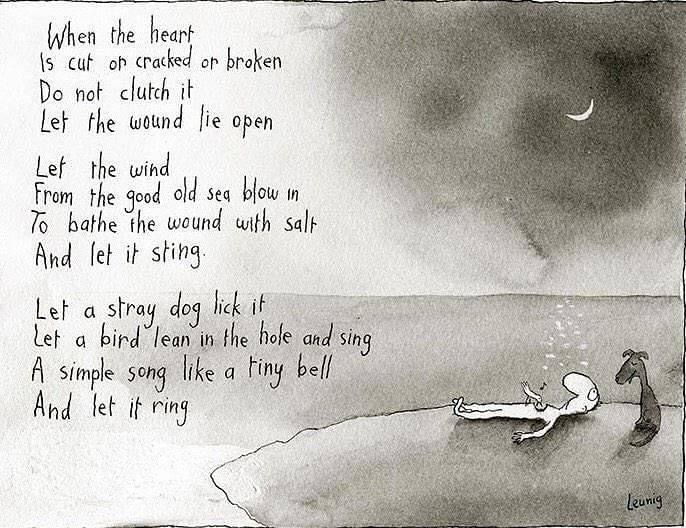
And then, as if to reassure us that everything would be ok, the current day prophet Leunig popped up on my news feed with these words of wisdom too:

Don’t be alarmed. Proclaim the good news. Do not worry.

Destruction doesn’t get the final word. Resurrection is on its way. Amen.

A new look at the Widow’s Mite…

1 Kings 17:8-16       Psalm 146                Hebrews 9:23-28   Mark 12:38-44

How often do we genuinely approach scripture as if for the first time?

Usually we scan a passage, recognise the key figures, and assume we know the moral of the story – just as I did this week. Ah, the widow’s mite. We know the message of this one; loving and serving God demands my soul, my life, my all. Give everything. And then, something happens – something as seismic as the election of a president, and something as minor as reading a commentary from decades ago – and suddenly, the passage takes on a new message that is so ‘other’ to what I was previously taught, so opposite from what I previously believed, even what I preached before, that it stops you in your tracks.

I thought I knew this passage – Jesus and his disciples are watching the worshippers going into the temple. Some swan around in their wealth and riches and cascade their coins into the treasury. Jesus is not pleased with them. The widow brings her two copper coins and is highly commended for giving all she has. But is that what happens? I don’t think it is.

For sure, Jesus is very clear of his condemnation of the scribes – ‘beware’, he says, ‘they devour widow’s houses for the sake of appearance… they will receive the greater condemnation’. But does he commend the actions of the widow? ‘She, out of her poverty has put in everything…she had to live on’. It’s an observation, not necessarily a commendation. And when we read it alongside the verses from our other readings, they shed useful light on it too…

In our Old Testament reading we meet another widow. We hear her say, ‘I have only a handful of meal in a jar…I am going home to prepare it for myself and my son that we may eat it and die’ and Elijah tells her she will not die but will be cared for by the Lord until the rains come.

And our psalm is clear too: ‘the Lord executes justice for the oppressed…gives food to the hungry…lifts up those who are bowed down…watches over the strangers…[and] upholds the orphan and widow’.

God’s opinion of the poor and the widow is abundantly clear. God’s directive for how these groups of people should be cared for is unquestionable; care, lift up, give, watch over.

So, a new reading of this gospel passage might decry the systems that command this poor widow to give her last two coins before she can enter the temple. It condemns the rules that say only the rich can enter. It disrupts the processes that keep the rich at the front, relegate the poor to the back whilst taking their last coins so all they can do is go home to die.

The Lord of Heaven and Earth is very clear. Poverty is avoidable. It should not be a terminal illness. And we, as the world’s rich, are the medication to heal it. The world’s rich, are God’s solution to ending poverty and oppression.

So how have we got this so wrong?

How are we those who perpetuate poverty, even perpetrate it.

And while I haven’t made a complete u-turn from my deepest belief that following Jesus does mean giving up my own rights, my own comfort, even my own wealth – that still remains true – I am beginning to hear, in this gospel passage, that sometimes following Jesus looks like being the one who makes sure the widow has enough to live on, rather than demanding she give her last coin to the treasury. It has become a cry to see the systems that keep the poor as poor as possible – even to the point where they must donate their last coin to the wealthy, and go home to die. In the economy of God, we cannot be those people. We must not build or maintain those systems and, if we look ahead to next Sunday’s readings, Jesus continues this message and talks about the destruction of those systems.

But we are here in this week, in this place in history, where more than 74 million people voted to be led by a man who makes promises for mass deportation of immigrants, whilst giving tax breaks for the top wage earners; whose policies end diversity, equity and inclusion programs, while denying climate change and increasing drilling for fossil fuels which, of course, has a catastrophic impact on the world’s poorest first. He will restrict education for those who are poorest and only permit medical aid for those who work. He will keep the rich rich, and take the last two copper coins from the world’s poorest before sending them home to die. And I am sorry if mixing politics and religion is not palatable but these choices, this behaviour, is not what is asked of us when we sign up to follow the prince of peace.

We are asked to put more coins into the hands of those who think they are on their way home to die…and give them the promise of life. And we are asked to dismantle the systems that make them believe they must give that last coin in the first place.

This precious widow in our gospel reading did not need to give money before she was acceptable to God and beloved in God’s sight. And if she did die of poverty, then surely, she is one of the most glorious saints in light. As I say, so many times, there is enough wealth in this world for everyone – enough and some to share. What we need is an equitable sharing of it, and a bringing down of those systems that exist to line the pockets of the fat cats and starve the poor to death.

Every three years in the Anglican church we get the same readings from scripture. This time around the widow and Jesus are calling loudly to me to care for the poor, raise up the downtrodden, call out the systems of oppression – even destroy them. And because that is such a scriptural imperative, I think they always were.

Give us ears to listen, eyes to see, wealth and willingness to make change and voices to speak out for those who are kept silent. Amen.

Say yes…then shut up!

Isaiah 53:4-12 Psalm 91:9-16 Hebrews 5:1-10 Mark 10:35-45

Last week, Revd Ros read the story of the rich ruler. This morning’s gospel passage follows almost directly on from that one. Almost, but not quite, because those who compile the lectionary chose to leave out 3 little verses. Three verses that change the context of this morning’s passage, pretty significantly…

They say this, ‘The disciples were on the road, going up to Jerusalem, and Jesus was walking ahead of them… He took the twelve aside and began to tell them what was to happen to him, 33saying, ‘the Son of Man will be handed over, and they will condemn him to death; 34they will mock him, and spit upon him, and flog him, and kill him; and after three days he will rise again’.

1

For the third time in a few days, Jesus tells his disciples he is about to be arrested, beaten and killed; he’s going to die; and James and John respond with, ‘Teacher, we want you to do for us whatever we ask of you.’ Do for us whatever we ask.

And hasn’t it always been thus? How often do we approach Jesus in that way? Jesus here is my list; please do this for me. Sort this, fix this, make this go away and this happen… how often are we tempted to that?

But Jesus doesn’t answer their request; instead he says to them ‘you do not know what you are asking’. Can you drink the cup I drink? Can you be baptised with the baptism I am baptised with?

2

3

James and John are asking the man who is God to do for them exactly what they want. Their request of Jesus is the wrong way around; Jesus we want you to do for us whatever we ask of you… That doesn’t seem to be the right order of things at all.

How different would things be if we somehow managed to allow God to be God – total surrender – and didn’t ask for anything, but rather allowed the one who is the originator of all that is Good to do the asking of us. What if we listened rather than spoke? If we spent time consciously in the Lord’s presence, not saying, do for us what we ask of you, but rather saying give me the grace that I might do for you God, whatever you ask of ME. I will do whatever you ask of me – I’ll even drink the cup of suffering, and say yes to the baptism of death. I’m yours and I’m in. And then just wait.

4

What might God ask? What is it that God want each of us to do? In today’s reading God asks for service; serve those around us and love and serve God too, following the example of Christ.

The example of Christ is servanthood; total self-giving, always putting the needs of others before our own, always going the extra mile, choosing love and kindness, outdoing others in all that is good, and loving God with all that we have and all that we are and all that we do. If we spent our whole lives concentrating on that, what a difference we would find around us. If we committed to always serving others and loving God, first, and fully, and left our ‘do whatever we ask of you’ demands out, we may find that we were as close to God as if we were sat at God’s right or left hand.

5

I’ve been really thinking about these words this week and it has caused me to reflect on my own prayers. Since being in Australia I feel like the Holy Spirit has been inviting me into a deeper, wider, broader, space. When I first started getting into the ocean each morning the invitation that came to me was to ‘swim deeper’ – to swim in the depth of God’s grace like the parts of the ocean where hydrographers don’t even know where the seabed is. And to keep swimming. And as I have tried to respond to that invite, so I have found the words of my prayers falling away, until they just become Yes. I call them my ocean prayers and on a good day all I find myself simply praying is yes. Yes God, whatever it is; yes. Not asking anything, just swimming in that richness of grace and love, knowing that whatever God asks or gives or does is good and it is safe to say yes…and that there are probably no other words.

Because, as Jesus says, when we do ask, we don’t really know what we are asking. Lord give me a parking space – yuck.
Even Lord end world poverty – well, isn’t that ours to do, rather than absolving all responsibility to our shopping list God in the sky.

Instead of ‘my’ will be done, shouldn’t we always be asking for ‘thy’ will to be done?

Last week we were invited to give up all we had, sell all our possessions, and follow Jesus. And today, we see where that road goes. It is the road that leads to life, never forget that, but first it is the road that journeys through death. It costs us all we are and all we have, even our very lives.

6

7

Can you drink the cup I drink, Jesus asks? That’s not just the cup of wine from the last supper, but the cup of suffering that Jesus begs God to take from him in the garden of gethsemane. Can you drink from that cup James and John? Can you? Can we?

As we take this question seriously, may we take a break from asking anything of God; may we err on the side of silence rather than hollow requests; may we instead follow the example of Christ; loving God and serving one another, and giving all we have. May we simply say yes, and leave the rest to God. Amen.

8

We wish to see Jesus

Jeremiah 31:31-34       Psalm 119:9-16       Hebrews 5:5-14    John 12:20-33

I have a question for you: Why do you come to church? (You might be sat there wondering the same thing!) But genuinely, why do you come to church?

Our community is pretty fabulous, the coffee is fresh, there is often champagne, the choir always sounds great, sometimes even the preaching is ok. But what is it that draws you back, week after week? Or what brought you back after that long spell you had away from church? I’ve been thinking about it, and I have to believe that, as with the Greeks in this morning’s gospel passage, the bottom line about why we each come, is that we want to see Jesus.

You see, there are nicer people, better coffee, colder champagne, greater music and yes even better sermons, elsewhere, but the reason we come here – I might even dare to say, whether we realise it or not – is because something inside us is captivated, drawn, intrigued enough by the notion of God that we come along because we want to see more, maybe even touch, hold or taste more. Like those first century seekers, we want to see Jesus.

On Tuesday night I went to a different church for a meeting. I didn’t realise I was going because I wanted to see Jesus. I thought I was going because it was in my diary. But there I met this woman called Asuntha. Asuntha Charles is the National Director of World Vision in Afghanistan.

Born in a village in southern India, Asuntha was the last daughter in a family of six. There was no reason for her to go to school and every reason for her to be married. But Asuntha was born to a feisty mama who, whenever Asuntha asked ‘can i…’, replied with ‘let her have a go’.

Asuntha completed school and university and became a social worker, always seeking out women and children in the world’s poorest corners. More recently her work has taken her to Afghanistan. When Taliban rule began, humanitarian agencies were encouraged to pull out, but this tiny, brave, single woman refused to leave. She showed us photos of 5 year old girls she had rescued from the marriage they were being sold into, with men nearing retirement age. And she told us that she will work with girl children in that broken place until one of them becomes president.

I thought I was going to a meeting. I was. And in it, I saw Jesus.

Sir, we wish to see Jesus. Well, go and hear Asuntha. Go and see what people do in my name, he says.

The next day I went to share holy communion in an elderly care facility and I read them this bible passage and I told them how I had seen Jesus the night before, in the words and face of Asuntha. And then Janet spoke.

Four months ago she was given three months to live. But Janet knits. And she has a deal with her Lord that so long as there is wool, she will keep knitting. When the wool runs out, she will go home, she says. She is midway through her recent cancer treatment and feels rotten but wool keeps appearing in her room and she often has no idea how it got there. So, she addressed the group, saying, ‘I knit. I knit beanies and mittens and socks for prem babies. And sometimes, when I knit, a little teddy pops out and I give that to the babies too. And I do that as a reminder that Jesus loves them’. And she was not in the least surprised when I said I could see Jesus in her. She can see him too.

Sir, we wish to see Jesus.

Well, he is appearing in knitted bears and beanie hats in prem baby wards of Perth’s hospitals. You will see him there.

And we come here with that same request – we wish to see Jesus.

And we might glimpse him in the scripture, or hear him in the melody of the hymns, we may hold him in our hands; eat and drink him in the mass, and at the end of the service I will send you on your way with these words; ‘May you see the face of Christ in everyone you meet, and may everyone you meet see the face of Christ in you’.

Sir, we wish to see Jesus – he is right here – around you and within.

Or, to use St Patrick’s words, whose feast day we remember today;

Christ is with you, Christ before you, Christ behind you, Christ in you,

Christ beneath you, Christ above you, Christ on your right, Christ on your left,

Christ when you lie down, Christ when you sit down, Christ when you arise,

Christ in the heart of every one who thinks of you,

Christ in the mouth of everyone who speaks of you,

Christ in every eye that sees you, Christ in every ear that hears you.

You wish to see Jesus?

He is right here.

Let us pray:

God. We wish to see Jesus.  Show us where we might find him.

Open our eyes, unclog our ears to hear him, make us attuned to where Jesus shows up.  Show us Jesus in the changing of the seasons; in the warmth of the sun and the cool of the clouds.

Share Jesus with us in waves on the beach that are made of the same water that lapped on the shore when he roasted fish with his disciples after the first Easter. 

Show us Jesus in those we look up to and respect. 

Show us Jesus in those who serve others, in those who bring new life into this world, and in those who care for us after death. 

God, show us Jesus in the places and people we don’t want to see Jesus in. 

Remind us that they share a spark of the eternal life of Christ, even if we might not see it, even if they might not see it. 

Show us Jesus in a world that doesn’t look like the one Jesus proclaimed and show us Jesus calling us to make that world a reality. 

God, we wish to see Jesus. 

We want our eyes and ears and hearts to be open.  God, refresh us with Jesus. 

Amen. 

Turning Tables

Exodus 20:1-17        Psalm 19     1 Corinthians 1:18-25         John 2:13-22

At community breakfast yesterday I was treated to some of the more colourful stories from the life of St Paul’s. Like the time someone came right up to the altar, rummaged in the offertory plate, and helped himself to a few fifties and twenties before running off with them. Or the time someone put their hand up towards the end of a service and confessed, before God and the congregation, that they had taken and drank every last drop of the communion wine.

And that made me wonder, how the people in the temple recounted the story of Jesus’ actions that we just heard.

The Passover of the Jews was near, and Jesus went into the temple and found people selling cattle, sheep, and doves, and the moneychangers seated at their tables. He made a whip of cords and drove all of them out of the temple, including the animals. He poured out the coins of the moneychangers and overturned their tables. And then he told them, “Take these things out of here! Stop making my Father’s house a marketplace!”

It would’ve been one of the more memorable days at the temple. Surely it would’ve been talked about for generations! Just like those stories from the past years of this place.

So, on three different occasions this week, different people told me about the man who stole from the offertory plate. And in each retelling, the speaker knew that if that man had only asked for money here, it would’ve been given to him. That this is a place of giving, of provision, a place where those in need can come for help.

And what I heard in the tale of the person who took and drank the communion wine is that this is a place where we can ‘fess up to things we have done wrong. It is a place we can come as we are and say ‘yeah, I messed up’ and we will still be accepted, and find forgiveness. And it’s also a place where everyone is welcome to eat and drink our holy meal – all are welcome. You don’t need to sneak in and steal it, just come hungry and thirsty and hold your hands out and it is yours. And there’s nothing you can do to be more worthy and nothing will prevent you from being able to receive.

So when the temple goers and the disciples left the temple that day and recounted the story, what would they have said?

First, Jesus was really cross. Take these things out of here, as he cracked his newly made whip. And he overturned the tables and scattered the money everywhere. Stop turning my father’s house into a marketplace.  But the thing is, the temple system ran on a marketplace sort of principle. You had to have money changers so worshippers could change regular cash into temple coins. And you had to have animals for sale so people could buy what they needed for their sacrifices. That was how it worked. So this outburst, this anger, ran way deeper. He wasn’t just clearing out the traders – he was clearing out the whole temple system. He wasn’t just overturning the seller’s tables – he was overturning the way things had been done for generations. He was flipping systems.  He was changing everything forever.

In that act, Jesus is saying there is no longer those who are in and those who are out. There is no longer those who can afford to worship and those who are too poor. There is no longer a case where the rich and/or corrupt govern this place. It is not based on a financial interaction, nor on animal sacrifices. This is a new era. This is my father’s house – it is his home – he decides who comes in, and all are welcome here.

I don’t want your money. I don’t want you to buy me a sacrifice. I don’t want spilt blood. I simply want you – all of you – body, mind, soul, spirit, all you have and all you are, all you own and all you lack. I want it all.

And as it was then, so it is now.

There are no rules, no systems, in place that can or will stop anyone from coming to Christ – except for those that we might put in the way. And every time we block or stop others from coming into God’s presence, Jesus is right there ready to knock that over and turn it upside down and clear it out. And that is as true in this place as it is in the temple of our hearts.

You see, we come together in this place, in this temple, and Christ constantly waits to welcome us, and Christ constantly waits to challenge us to remove any blockages we have here.

But we are also walking, talking, living, breathing temples of God’s spirit. And I wonder what God might be eagerly waiting to clear out from within us too.

What blocks, what systems, what beliefs, what restrictions do I have in my own heart that prevent true worship from being able to take place there? What hurt, what self-doubt, what utter independence or pain am I storing up in my heart that needs clearing, yes even with a whip of cords.

Jesus walked right into that temple in Jerusalem and did the clearing, uninvited. I hope he will walk right in here too and clear anything that offends him or blocks out others. This is God’s place, God’s house, and God doesn’t need an invitation to be here.

But when it comes to the temple of our heart, Christ won’t barge in. He waits for an invitation. We can choose to hold onto and perpetuate those systems that keep God out. We can set for ourselves rules and regulations that we must reach, and then fail to reach. And Christ is always waiting to dismantle them.

So, in the stillness and the silence will we whisper our invitation for him to come in and clear out, that our worship may be pure, unblocked, expansive, inclusive, and wholehearted, because that is the worship that is acceptable in God’s sight. Amen.