Advent II – Year C

Malachi 3:1-14     Psalm: The Song of Zechariah (Luke 1:68-79)

Philippians 1:1-11           Luke 3:1-6

This week has been wild. With squashed banana and congealing yoghurt, and sticky fingers on every pane of glass, there isn’t much purifying going on in the rectory and if this sermon begins to go all singsong, like a nursery rhyme, then I’m sorry, but we’re upright, and that’s the best we can expect right now, right?!

Fortunately, this is one of my most favourite passages in the Hebrew scriptures, this prophesy from Malachi about the coming king. Hear it again…

See I am sending my messenger to prepare the way before me, and the Lord whom you seek will suddenly come to his temple… He is coming. But who can endure it?  For he is like a refiner’s fire.  He will sit as a refiner and purifier of silver.

Such rich imagery. What a clear picture. A refiner’s fire, a purifier of silver.

Several years ago, I investigated what it is that a silversmith does and, it was as I read that this passage rocketed up the list of favourite verses. Do you know how a silversmith refines metal?  Do you know how a goldsmith tests for purity?  Maybe I’ve told you before.

They sit, for long periods of time, holding the metal in very intense heat and they keep it there until the dross burns off and it is free from impurity.  They burn it to make it clean. And how do they know it is pure?  What is the test? It is only complete once they can see their own reflection in it.  The face of the one who creates it.

So, what does this prophecy say for God’s people?

The Lord is coming.

And in God’s coming is the promise that we will be held in God’s fire until all that is dross burns away, and until God sees us as pure, and as perfectly reflecting God’s own face.  We, and all God’s people, down through the ages, will be made perfect, so we can reflect the image of the Divine Silversmith – so people will look at us and see the Great Creator.

And as a gold or silversmith sits at their refining fire, are they concerned about the impurity? Do you think they spend time worrying about the dross and the grime? I bet they don’t. I expect they know that all that is precious is right there waiting to emerge, waiting to bubble to the surface. They simply hold that precious metal in the fire until their own face can be seen in it and then they know it is ready.

‘The Lord whom you seek will suddenly come to his Temple’, says Malachi.

He promised this to God’s people 400+ years before…and then there was silence… nothing.

God’s people, through the ages, knew they were waiting for The One to come to the temple, ready to refine and purify, and reflect the image of the creator. Maybe they would be the generation that would be chosen to next reflect the glory of God. Always watching, listening, waiting, hoping. But for centuries it all went quiet…

And then suddenly we get this crazy prophet bursting onto the scene. John; the last of the Old Testament prophets, cries out in the wilderness, ‘prepare the way of the Lord, make his paths straight. Every valley shall be made straight, and the rough ways made smooth, and all flesh shall see the salvation of God.

The time has come.

The time of purifying and refining, the holy burning, to remove the dross and reflect the Glory of the Divine…it is near.

Who can endure the day of his coming, and who can stand, Malachi’s prophesy asked. And I wonder what that is asking of us, here and now. Who can endure? Who can stand? Will we give in to the process of our creator, whatever it takes and wherever it takes us, so that we can be made pure – not sinless, not shiny clean, I don’t mean that – I mean truly pure so that, in the words of our gospel prophet a few decades hence, ‘we must decrease, and you must increase’.

God making us pure means seeing more of God in us. More of God and less of self, less of ego, less of our own good works and more of God’s work.

And that’s tricky, right, because we want to do those things that God asks of us, and sometimes we get in the way of God’s glory being seen, sometimes we might almost block out the light. So we must return again and again to the refining fire and hand ourselves over to the Divine Jeweller – make of me what you will, Great Creator – take my simple offering, my tasks, my hopes, my attempts, my heart and soul and burn off all that is impure and make it pure.

Handing ourselves over, even once, let alone over and again, sounds uncomfortable, risky even. Maybe that’s why the prophecy asks ‘who can endure and who can stand’. Knowing we are delivering ourselves into Hands, even the holiest of hands, where all that is purely-self is potentially painful. What if I like the bits that are burned away? What if I was particularly attached to them? But, it is the call of those who are seeking after God. It is the offer, the invitation, that we might be made refined and pure, that we might reflect God’s glory and not our own.

Uncomfortable, yes. But how liberating? Imagine the freedom of complete purity.

Yesterday Gabby posted another fabulous Gabby image on our Facebook page, with words from the Indigenous Leader, Steven Charleston. His poem ‘Wild Places’ perfectly span our two prophets for this morning – Malachi and John the Baptist. He writes this:

A voice crying in the wilderness.

The call of the Spirit does not come in quiet places of comfort.

It beckons us from wild places: that interior wilderness, just outside the walls of polite society.

The dark woods where we are afraid we may meet the stranger.

It is the risky land of encounter.

The invitation of the Spirit is to go out by going in.

To question what we know.

To encounter what we fear. 

We are purified not with drops of water but with beads of sweat.

Amen.
Advent 1 – Hope

Jeremiah 33:14-16          Advent Prose         1 Thessalonians 3:9-13             Luke 21:25-38

Very occasionally I have a solid idea for my sermon on a Thursday. Even more rare is it that I have actual words on the page before my day off on a Friday. This week, I thought I had both. It was almost finished. I’d made the decision to preach on the Old Testament readings through Advent. Just after 5pm, I sent off a last-minute email and my day off was about to begin…and then the phone rang. And less than 45 minutes later, life at the rectory was pretty significantly changed, and my sermon draft with it.

The book of Jeremiah is full of messages of judgment, and promise.  Each of his promises from God point to a new world, where justice, righteousness, and peace reign. Jeremiah speaks these words, from his prison cell, to a people who have been torn apart by war, injustice, and exile. They have lost their homes, their city, their temple. He has lost his freedom. And they are longing for a way out, for restoration, for hope.  In their suffering, God gives them a promise that reaches towards a future reality: “The days are surely coming…”

God promises that a day is coming when all things will be right. Justice will be restored, broken systems will be healed and a society will be established where everyone can live with dignity and safety. God is promising to bring forth a righteous Branch—one who will do what is just and right in the land.  This is not a distant, abstract concept; it is concrete and urgent. The idea of a righteous ruler in the tradition of David is about political and social justice; one who would lift the oppressed and protect the vulnerable.

As Christians we dare to believe that Jesus is the fulfilment of this prophecy. But more than that, we might make the audacious claim that we have a part to play in its fulfilment too; that we, more than 2000 years after this was fulfilled in Christ, must give our lives to create justice, challenge oppression, speak a language of respect and kindness, call for peace, bring healing to the planet and to those who suffer most. We hear Jeremiah’s prophesy, see it’s fulfilment in Christ and STILL hear a call to action for us; a call to engage in the work of holy justice, now. And if we hear it that way, what might that look like? What might that demand of us?…

And that was about as far as I got, by Thursday evening.

I thought it was fine, y’know. But who wants to hear ‘fine’? Who wants to follow a God who is fine?! I didn’t really want to preach something fine. But then the phone rang.

It was quarter past 5, on Thursday evening, and it was a number I didn’t know. The woman introduced herself as working for the department of child protection. Craig and I have had a few fleeting interactions with DCP because we occasionally provide respite care for one child. We aren’t approved to do more than that. The woman knew her request was a longshot, but she wondered if we might have room for 2 brothers to stay for that night. All other avenues had been exhausted.

You have heard me, over and over, make grand calls for action; but I was terrified! Anyway, we said yes, and we said yes again ten minutes later when they called back to ask if we could make space for their baby sister too.

And in the middle of nappies and escape attempts and cooking experiments and horrendous stories of neglect and abuse unfolding in front of us, there were times where I could pause and observe long enough to realise this is what the work of executing justice and righteousness really is. And our call in the rectory might be different from yours, but this is what it looks like for the baby sister, right now.

We follow a God who’s name is Righteousness and what could be more right-making than restoring hope where it has been lost, and planting it where it has never been known.

And our first advent candle is the one we light for Hope.

Hope sees the police raid a tent, to rescue three small children so a bright future might still be possible (it’s not just possible, it’s on its way, maybe).

Hope sees an imprisoned prophet promise days are surely coming where justice and righteousness will be clear and present.

And get this, Hope sees a young family bring their child for baptism because perhaps they are looking for a way back to church…and when they randomly select this day, they choose Hope Sunday…and their baby is named Paige Hope.

This God of righteousness and hope is a tricky customer, a radical saviour, a holy fulfiller of ancient prophesies, and we are still being called and drawn and trusted to be the hands and feet that deliver hope and righteousness to the world, today.

In this generation, we see communities torn apart by violence, racial injustice, inequality, and environmental degradation. Families struggle to make ends meet, and marginalized groups fight for basic rights and recognition. The promise of God’s justice is that these things will not have the last word. God’s vision, God’s HOPE, is that safety is not a privilege for a few but a right for all.

So as we reflect on these words from Jeremiah, we are reminded that God’s promises of restoration and justice are not abstract ideas—they are concrete, and urgent. And some of them will be brought about by us. Some of them can only be brought about by us, even. We are the ones who are called to embody the justice and righteousness of Christ in every area of life.

Let us be a community that continues to make present the vision of God’s Kingdom for all, and when that feels overwhelming and impossible, may we heed the advice of Mother Teresa, who famously says, “Never worry about numbers. Help one person at a time and always start with the person nearest you.”

Amen.

Another World is on its way…

Daniel 7:9-10,13-14        Psalm 93                 Revelation 1:4b-8           John 18:33-37

One of the most beautiful things I ever heard is from the Prize-Winning Author, Arundhati Roy, who wrote ‘another world is not only possible; she is on her way. On a quiet day, I can hear her breathing’. Isn’t that stunning?

Back in 2017, I accidentally landed up being part of an American cohort of preachers – I say accidentally, because I’m not American – and we were given funding to develop a project that preached resistance, through word and song. Preaching resistance, with gospel passages like this was a simple task and one of our group wrote a chant from that beautiful quote. You can see the words on page 6 in your service book and I’m going to step out of my comfort zone and teach it to you.

It goes like this:

Another world, another world is not just possible it’s on its way

And we sing that twice. Let’s try:

Another world, another world is not just possible it’s on its way

And then it goes…

And I can hear it breathing, and I can feel it coming

It’s not just possible, it’s on its way.

Let’s try that…

All week I have been singing it because it encapsulates what happens in these verses from John’s gospel.

A beaten and bloodied Jesus is before Pilate and is asked ‘what have you done?’.

And Jesus doesn’t answer the question.  Not specifically.  But he could.  He’s got a whole resume of things he’s done.  What have I done? I’ve healed the sick and raised the dead.  I have eaten with outcasts.  I have spent time with the hated and kissed the untouchables.  I have spoken against lies and falsehood and injustice.  And I have inspired others to do the same – fishermen, tax collectors, women – they’re springing up all over and are feeding the hungry and claiming I am the messiah.

But he doesn’t say any of that.

What have you done, Pilate says. And Jesus answers, “My kingdom is not from this world… My kingdom is not from here.”

Jesus reigns over a kingdom that is unrecognisable to Pilate.  His kingdom is not like the kingdom of Caesar or Pilate or Herod; a kingdom operating on violence and oppression.  It was, and is, entirely other.

What have you done Jesus? 

What had he done? 

He had turned the whole kingly order of things upside down.  He had not lived as a king and he was not ruling as a king, and his crown was about to be one of thorns and his throne was about to be a cross of wood.  What have you done Jesus?  This is not kingly.  Are you really the king?

And Jesus never confirms whether he is or isn’t. But his actions say more than words ever can. He’s creating a new world, and it’s not just possible; it’s on its way. And it is unstoppable. It has been coming since the dawn of time, and it is still on its way.

In this generation, people are looking for help and looking for a way out, and for freedom and liberation, and they might glance at the church and wonder if maybe it could be true.  What has Jesus done?  Could he be our King?  Do we need a King or a kingdom different to what we’ve got?  We need something other, something trustworthy and true.

What have you done?

And what are you doing?

Can I join in? Is there space for me?

For those of us who are trying to follow Christ as King, and align ourselves with the values of his rule and reign, we might dare to believe the Kingdom of God is not just possible – she’s on her way. And on a quiet day, we might hear her breathing.

Another world, another world is not just possible, it’s on its way…

What have you done, Pilate asks?

And now Jesus asks us the same question…

What have you done? Are you co-creators in my building of this other world?

And that really got me thinking because if we can hear it breathing, and feel it coming, what might it sound and feel like? And if we are going to choose to create those things along with our Divine Creator, what might they look like.

This ‘other world’ that is on its way is good and just and equitable. And every time we pray ‘your kingdom come, your will be done on earth as in heaven’ we are committing and recommitting to be a part of the construction team; to be kingdom builders to create this other world that’s not just possible, it’s on its way.

What have we done, what are we doing, to point to the Kingdom of Christ here, in Beaconsfield?  A kingdom of peace and non-violence; a kingdom of life and light and love and freedom; a kingdom of good news, where the hungry are fed and the homeless are housed, where the naked are clothed and the lonely have friends; where prisons and hospitals are empty, and the environment is clean and green. 

Every time we contribute to something of light, we starve out a piece of darkness. Every time we light a candle of hope or gentleness or kindness in a situation, an element of darkness is snuffed out. And we can choose to create. We can choose to construct and build. And we can choose not to.

Another world is possible. The reign of Christ really is unstoppable. She’s on her way but she doesn’t come with drones and weaponry and she doesn’t kill or destroy. She builds up and rebuilds and blossoms and brings life. And this new world is so compelling, and it requires our input. And we can choose to be divine builders, because there is space and work for us all.

Pilate asks Jesus, ‘what have you done’?

Jesus asks us, ‘what have you done? What will you do? Will you be part of the building of this other world?’

So we have a choice to make – we can stay as we are, feet firmly rooted in this time and place, or we can summon our courage, listen for the new world, hear her breathing and join in. it’s not just possible, it’s on its way…

Another world…

Apocalypse Sunday

Daniel 12:1-3         Hebrews 10:11-14,19-25          Mark 13:1-11

The 16th Century church reformer Martin Luther once approached this passage, relying on the promise at the end, ‘do not worry beforehand about what you are to say; but say whatever is given you at that time’. He is said to have ascended into the pulpit without a single thing written and asked the Holy Spirit for the words to say, and he received this answer; Martin, you have not prepared.

So that scuppered that approach!

Last week we heard Jesus’ commentary on the widow, as she entered the temple, and dropped her last two coins in the treasury, before going home to die. They were demanded of her, presumably to fund the large stones and large buildings that are impressing the disciples so much in today’s passage.

‘Look at them’, they say! And Jesus says ‘do you see these great buildings? Not one stone will be left here upon another; all will be thrown down’. And he continues later, in private, with the closest of his friends, with his apocalyptic discourse.

This Sunday in the church year is always Apocalypse Sunday, before we reach Christ the King next week, and then move headlong into advent. We always hear about the so-called ‘end times’, just before we move into the promise of the dawn of the new era where Christ reigns and the upside-down kingdom of love is ushered in.

But this week The Anglican Church had something of its own apocalypse when Archbishop Justin Welby announced his resignation after the results of the Makin report were published.

The report exposed the failings of the church to protect and respond to vulnerable boys who had been systematically abused in the most horrendous ways; including physically and sexually. The archbishop had become aware of this and informed the police in 2013, but action was not taken and the abuse was allowed to continue, was even silenced and covered up, until the death of the perpetrator in 2018, and even beyond. Archbishop Justin’s statement said he ‘must take personal and institutional responsibility for the long and retraumatising period between 2013 and 2024’. And even this week more and more boys, now men, are coming forwards and their pain is palpable and the archbishop’s resignation is not the comfort they hoped for.

And while all this was unfolding in the world’s media, these bible verses were waiting to be proclaimed in churches across the Anglican communion, worldwide, today. Social media was full of cries for his resignation and then sadness at the same. One priest friend wrote ‘you can take a brick from the top layer of a jenga game and nothing changes’, but it felt more like someone had pulled the brick from the bottom.

But Justin Welby is just one stone amidst the living stones of God’s Holy Temple, the Church – and so are we. So, this passage calls for something far more radical than the resignation of one man, even if it is the Archbishop of Canterbury.

Here, in the first century, Jesus predicts the destruction of the temple that indeed came to pass but is it also true that there are times in history when the whole temple of God needs a total breakdown, a total rebuild, and if God were to do that with God’s church here and now in the twenty first century, what might be rebuilt in its place? What would be kept and what would be broken and remade into something new?

And more pertinently, if God were to destroy and rebuild the temple of our hearts, what would be lost, what would be refined, what would be cherished, what would be encouraged to grow in its place? Big questions!

How would God reshape and remake the Church, universal?

How would God reshape and remake our heart? Your heart?

The disciples ask Christ for a sign – how will we know that all these things are about to be accomplished and his response is detailed; beware no one leads you astray, people will say all kinds of things but don’t be alarmed. He speaks of wars and earthquakes and famines, and he talks about birth pangs, about labour.

Wars, earthquakes, persecution, and this is only the beginning?! Destruction and rebuilding sound painful.  And for any of us who have been through a church split, or a marriage breakup or bereavement or any other kind of deep dismantling and rebuilding then we know that it is painful. It can even feel like we might just die.

But in our gospel reading today, Jesus has wise words for his followers – in these few verses he tells his friends, he tells us, beware…don’t be alarmed…proclaim the good news…do not worry. Those words promise beauty for the brokenness of the temple, hope for the brokenness that springs from historic abuse, or broken promises, or deep deep grief.

Don’t be alarmed. Proclaim the good news. Do not worry.

And that feels like wise advice for today, just as it was for those first century disciples too. It’s going to get bad. Maybe it already is bad. But don’t worry. You might feel like you’re even in the middle of death but resurrection is on its way. That’s always the promise, isn’t it. even in the deepest, darkest place of death, resurrection will still win. Destruction doesn’t get the last word. Redemption does. Do not worry.

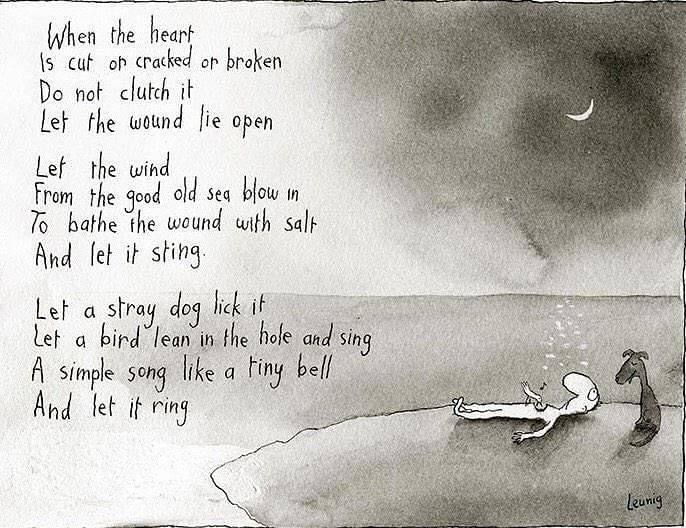
And then, as if to reassure us that everything would be ok, the current day prophet Leunig popped up on my news feed with these words of wisdom too:

Don’t be alarmed. Proclaim the good news. Do not worry.

Destruction doesn’t get the final word. Resurrection is on its way. Amen.

A new look at the Widow’s Mite…

1 Kings 17:8-16       Psalm 146                Hebrews 9:23-28   Mark 12:38-44

How often do we genuinely approach scripture as if for the first time?

Usually we scan a passage, recognise the key figures, and assume we know the moral of the story – just as I did this week. Ah, the widow’s mite. We know the message of this one; loving and serving God demands my soul, my life, my all. Give everything. And then, something happens – something as seismic as the election of a president, and something as minor as reading a commentary from decades ago – and suddenly, the passage takes on a new message that is so ‘other’ to what I was previously taught, so opposite from what I previously believed, even what I preached before, that it stops you in your tracks.

I thought I knew this passage – Jesus and his disciples are watching the worshippers going into the temple. Some swan around in their wealth and riches and cascade their coins into the treasury. Jesus is not pleased with them. The widow brings her two copper coins and is highly commended for giving all she has. But is that what happens? I don’t think it is.

For sure, Jesus is very clear of his condemnation of the scribes – ‘beware’, he says, ‘they devour widow’s houses for the sake of appearance… they will receive the greater condemnation’. But does he commend the actions of the widow? ‘She, out of her poverty has put in everything…she had to live on’. It’s an observation, not necessarily a commendation. And when we read it alongside the verses from our other readings, they shed useful light on it too…

In our Old Testament reading we meet another widow. We hear her say, ‘I have only a handful of meal in a jar…I am going home to prepare it for myself and my son that we may eat it and die’ and Elijah tells her she will not die but will be cared for by the Lord until the rains come.

And our psalm is clear too: ‘the Lord executes justice for the oppressed…gives food to the hungry…lifts up those who are bowed down…watches over the strangers…[and] upholds the orphan and widow’.

God’s opinion of the poor and the widow is abundantly clear. God’s directive for how these groups of people should be cared for is unquestionable; care, lift up, give, watch over.

So, a new reading of this gospel passage might decry the systems that command this poor widow to give her last two coins before she can enter the temple. It condemns the rules that say only the rich can enter. It disrupts the processes that keep the rich at the front, relegate the poor to the back whilst taking their last coins so all they can do is go home to die.

The Lord of Heaven and Earth is very clear. Poverty is avoidable. It should not be a terminal illness. And we, as the world’s rich, are the medication to heal it. The world’s rich, are God’s solution to ending poverty and oppression.

So how have we got this so wrong?

How are we those who perpetuate poverty, even perpetrate it.

And while I haven’t made a complete u-turn from my deepest belief that following Jesus does mean giving up my own rights, my own comfort, even my own wealth – that still remains true – I am beginning to hear, in this gospel passage, that sometimes following Jesus looks like being the one who makes sure the widow has enough to live on, rather than demanding she give her last coin to the treasury. It has become a cry to see the systems that keep the poor as poor as possible – even to the point where they must donate their last coin to the wealthy, and go home to die. In the economy of God, we cannot be those people. We must not build or maintain those systems and, if we look ahead to next Sunday’s readings, Jesus continues this message and talks about the destruction of those systems.

But we are here in this week, in this place in history, where more than 74 million people voted to be led by a man who makes promises for mass deportation of immigrants, whilst giving tax breaks for the top wage earners; whose policies end diversity, equity and inclusion programs, while denying climate change and increasing drilling for fossil fuels which, of course, has a catastrophic impact on the world’s poorest first. He will restrict education for those who are poorest and only permit medical aid for those who work. He will keep the rich rich, and take the last two copper coins from the world’s poorest before sending them home to die. And I am sorry if mixing politics and religion is not palatable but these choices, this behaviour, is not what is asked of us when we sign up to follow the prince of peace.

We are asked to put more coins into the hands of those who think they are on their way home to die…and give them the promise of life. And we are asked to dismantle the systems that make them believe they must give that last coin in the first place.

This precious widow in our gospel reading did not need to give money before she was acceptable to God and beloved in God’s sight. And if she did die of poverty, then surely, she is one of the most glorious saints in light. As I say, so many times, there is enough wealth in this world for everyone – enough and some to share. What we need is an equitable sharing of it, and a bringing down of those systems that exist to line the pockets of the fat cats and starve the poor to death.

Every three years in the Anglican church we get the same readings from scripture. This time around the widow and Jesus are calling loudly to me to care for the poor, raise up the downtrodden, call out the systems of oppression – even destroy them. And because that is such a scriptural imperative, I think they always were.

Give us ears to listen, eyes to see, wealth and willingness to make change and voices to speak out for those who are kept silent. Amen.

All Saints and All Souls

Isaiah 25:6-9          Psalm 24            Revelation 21:1-6a           John 11:32-44

(Today we celebrate All Saints Day and remember All Souls; the souls of those we have loved and lost and who are now counted among the saints in light).

For someone who was brought up conservatively Baptist, I have a surprising devotion to the saints. I love the big hitters, particularly blessed Mary and Mary Magdalene, but they are merely the beginning of my saintly interest. When the Church went online for those long months of COVID our dispersed virtual congregation accidentally formed a new worshipping community under the watchful eyes of Ss Isidore and Carlo; the patron saints of the computer, and the internet. And this week I discovered the delight that is St Drogo – the patron of coffee, insanity and unattractive people and uncovered the irony that it’s St Gemma who’s the saint of all things back pain related. Who knew?!

And while we might petition St Anthony when we lose something, I am more interested today in the quieter, less famous, more under-stated saints that are around us, both living and departed, every day – because today is ALL Saint’s day, not SOME saints day.

Today we pause, breathe deeply, and seek comfort in the assurances of our Old Testament reading, that tells us there are those now feasting with the Lord at a lavish banquet. We hold tight to the promise that death will be swallowed up forever; there will be no more tears, no disgrace, no more waiting – just rejoicing and gladness.

Today we wait, together, for the day when we and our loved ones will be reunited, with God, in the new heaven and the new earth; where God will fully dwell with all humanity – our tears will be wiped away, mourning and pain will be no more, and all things will be made new.

Today we collectively gather at the universal tomb of death as we eagerly wait for Jesus to come and weep with us, take away the stone, and call life to ‘come out’ again.

We gather in this liminal space where we know death and grief – where, for some, this is the first All Saints Day where our favourite human saint is at the eternal banquet instead of eating with us – we gather here where our memories of our loved ones cause anxiety because we can no longer remember what their voice sounds like, we can no longer hear their laugh or smell their scent. And we gather here, taking our place in the line of the Saints – holding the baton that is ours to run with at this time, until it is time to hand it over.

And as we gather to honour those who have allowed the light of Christ to stream through them and warm our own faces, so we recognise that we each have a role in allowing ourselves to be used as saints – light bearers – on the journey of life for another.

You see, we are all saints. We are all forgiven, redeemed, made holy, given grace. There are those who came before us – great champions of the faith, stretching right back to the dawn of time – and there are undoubtedly those who will come after us. And here we are, right now, with our own part to play, trying to spot the saintliness in one another. Sometimes our light is tarnished, sometimes it is easier to spot. Sometimes we mar the image of the creator as it seeks to stream out of us. Sometimes we look at another and it is like we look directly into the face of Christ.

Last year I told you my favourite All Saints story, about the little girl wandering through a church, looking at the imagery of saints in the stained-glass window, before saying to her mummy, ‘now I understand! A saint is the one the light shines through’. Absolutely.

A saint is the one the light shines through. And one of the reasons we miss those who have gone before us is because the light that shone through them was fascinating and beautiful and life-giving and beguiling. Our call, as baptised children of God is to be that light for others or, as our gospel reading puts it, to follow Jesus’ invitation and command to be – like Lazarus – unbound, so the light might stream out of us, unhindered, undistorted, too.

We have a lifetime to do this, a lifetime to make an impact, and forever to be missed – like those we remember today. We grow into saints throughout our earthly lives, every day, ready to receive the crown when we reach the eternal banquet. And this is a lot to take in – a lot to process.

Today, we allow ourselves the time in this sacred place to recall the souls of all the saints; living and departed. We allow ourselves the capacity to be surprised by feelings that come unexpectedly to the surface and we sit with them, hold them, maybe light a candle for them and allow them to float upwards and outwards towards God.

We take a pause to allow the Christ to do that next bit of work in unbinding us, so that God’s Light might beam more brightly through us and, as God does God’s gentle work of grace in all these feelings, we simply breathe, say yes, and allow it to happen. So let us pray…

Time to speak out!

Jeremiah 31:7-9   Psalm 126   Hebrews 7:21-28             Mark 10:46-52

Last week I led a session at Wollaston Theological College, for those training for ordination. I had one hour to talk about the role of the church in the world. A whole hour! I began with my favourite question – one you will almost certainly have heard me ask before. I asked them ‘what is the one thing you would stand up in court for, go to prison for, even die for?’ And we took time to consider that, and to explore what the role of the Church might be in these situations. And we talked about immigration and poverty and injustice, but then, as I read this week’s readings, I realise what we were really discussing was what it is we refuse to stay silent about. What is the thing that breaks our silence and makes us speak out?

Human trafficking, child sexual abuse, the environment, homelessness, addiction, education, lack of access to services, loneliness, care for the sick and elderly. What are the issues, what will we do, what should the church – God’s people collectively – do?

Often, the focus of the story of Bartimaeus is the miracle of the restoration of his sight. And that is remarkable. Miraculous. But that isn’t the thing that caught my attention most this week. It was all the noise!

In the Old Testament reading we have people singing aloud, raising shouts, proclaiming (you can’t do that quietly), giving praise, and weeping. In our Psalm there is laughter and shouts of joy and then we meet the blind man, sat on the roadside. Or rather, we walk past the blind man on the side of the road. Totally pass him by and don’t notice him at all and Blind Bartimaeus begins to shout out, ‘Jesus, son of David, have mercy on me’! Many order him to be quiet – but this is the thing he will break his silence over, and he cries out even more loudly, ‘Son of David, have mercy on me!’

The crowds are moving, the people are noisy and the voice that rings out above it all asks for mercy. People try to shut him up and Jesus stops. He stands still and he says, ‘call him here’ and they do.

The blind man refuses to stay silent when he knows his healing is available to him. He refuses to keep quiet, regardless of custom or tradition or respect. He cries out his own protest shout. And while we reflect on him breaking his silence, I wonder again what I might break my silence over. What is your Bartimaeus moment? When will we find ourselves standing alongside our own Bartimaeus and speak out for the sake of that man. What is it that will do away with our excuses of being too shy, not brave enough, not educated enough? What will open our hearts enough so our voices will follow?

And that leads me to ask the question, what will the church – worldwide – refuse to stay silent over? What loud calling voice do we need to hear from the church in the world, right now?

This past week I received an email from an organisation called ‘Palestinian Christians in Australia’, asking for the church in Australia to speak out against the genocide in Palestine. They wrote,

This past weekend, we commemorated one year since the Church of St. Porphyrios was hit by an Israeli airstrike, killing 22 and injuring 18 members of our community. Hundreds of Palestinian Christians remained sheltering [in churches] in Gaza. They have been there since October 2023, with nowhere to escape. Close to 200 have valid visitor visas for Australia. But the Australian government has not adequately supported them to leave Gaza, and now their visas are due to expire.

We are inviting Christian leaders around Australia to advocate with and for us. 

In direct response to this advocacy, the government has pledged just over $477,000 to Palestinian Christians in Australia to house families arriving from Gaza. We are thankful for God’s faithfulness, the Church’s support, and the government’s provision… But thousands of the Australia Palestinian community’s family members remain trapped in Gaza, suffering famine, destruction and bloodshed. We are calling for the Australian Church to join us once again, as we say, more must be done. 

We are inviting you to join the coalition of Christian leaders, as we call on the government to:

  1. Grant emergency humanitarian visas to thousands of Palestinians in Gaza.
  2. Provide sustained diplomatic pressure on the Israeli government about border crossings to allow safe evacuation from Gaza
  3. Provide assistance once these families arrive in Australia.

We are looking for churches to endorse the campaign…

And that makes me want to stand, like Bartimaeus did, and cry Lord Jesus, Son of David, have mercy on us…

Last week, I preached that sometimes we need to say yes to God and then stay silent. And that remains true. It is also true that sometimes we need to say more – not just in prayer, but in word and action, in letters, in protests, in court or parliament, online and in person. Sometimes we don’t have the luxury of remaining silent. Sometimes speaking out leads to healing and freedom. Sometimes speaking up shines the light on that which is wrong and brings about change.

The words of the collect at the start of the service captured it beautifully when we prayed, ‘Jesus Christ…you heard the cry of the blind beggar when others would have silenced him. Teach us to be attentive to the voices others ignore, that we might respond and heal and welcome, for the sake of the gospel.’

So, in a few moments of silent reflection, let’s consider the question I began with; ‘What is the thing that will break your silence and makes you speak out’. There are those who are waiting for your voice. Amen.

A sermon for St Francis Day 2024

Genesis 2: 18-25    Canticle of the Sun      Rev 5: 11-14        Matt 6: 25-29

Today we come to the end of our Season of Creation, and we celebrate the life and witness of St Francis of Assisi; the patron saint of animals, ecology and the environment. We began the season with John’s sermon on the Earth. He concluded that sermon with a beautiful quote from Pope Francis, so it seems fitting to begin this sermon with an equally wonderful quote from the same.  In his encyclical on the environment, thePope writes this tribute to St Francis:

I do not want to write this encyclical without turning to that attractive and compelling figure whose name I took as my guide and inspiration… I believe St Francis is the example par excellence of care for the vulnerable, and of an integral ecology lived out joyfully and authentically … He was particularly concerned for God’s creation and for the poor and outcast… He shows us how inseparable the bond is between concern for nature, justice for the poor, commitment to society and inner peace.

This is the third consecutive year we have celebrated the feast of this Saint, often described as being the most popular and admired…but probably the least imitated.

When we have celebrated this great saint in previous years, I have told you about his upbringing and his refusal of the family wealth. I have spoken about his hearing from God in a rundown chapel in San Damiano, where he received the call to ‘repair my church which is falling into ruins’…and the building projects that ensued. I have explained how he rejected his inheritance, publicly, nakedly and even violently at the hands of his rich father, and then went on to unintentionally form a monastic community of followers around him. And these are remarkable and admirable things about this saint. If these things pique your interest do go and read about them for yourself because this time around, I am captured by an account written by Dr Frances MacKay in her article entitled, Saint Francis; Saint as Holy Fool.

I think she would’ve liked Christabel’s explorations of humanity, because she writes, ‘I find myself wondering about the man behind the saint’, and I do too. And she goes on to explore his humanity and his rise (or stumble) towards sainthood.

She explains how grounded Francis was in his own humanity, how one of his brothers overheard him in prayer one night, asking over and over, ‘Who are you O God, and who am I?’ She says, ‘Like other mystics, he understood that the search for God and the search for his deepest self are two sides to the one coin.’

Who are you, O God, and who am I?

This was a question Francis asked his God throughout his life. It held answers that shaped his life and ministry and religious order. It is the basis upon which he penned that glorious canticle we just read together and that beautiful poetry of becoming a channel of God’s peace. This question, and his exploration of the answers, seeped into his bones. It meant he could see his place in all of creation; that God is all powerful, all good, worthy of all praise. And that we – the entire cosmos – belong to God and are siblings together in that huge family of creation; the sun is his brother; the moon is our sister; wind, air, clouds, storms, water, fire – they are all our siblings and we, and they, reflect something of God’s glory.

Who are you O God? You are the creator, the source of divinity, worthy of service.

And who am I? I am part of your family; your child, one another’s sibling. I am one who praises and worships. I enjoy creation. I revel in the beauty and power and strength and value and colour of all you have made, and I am sustained by it.

Who are you O God? You are the one who is Love

And who am I? I am one who forgives for love

Who are you O God? You are most high

And who am I? I am peaceful, I am happy, I am following you. I am thankful.

Francis’ two-fold question was everything. It was all he needed to go through life. Knowing God, and knowing himself in relation to God directed all he did. It was these two questions that took him from his lofty ambition of being a knight and a troubadour, carried him through sickness that brought him near to death. These questions took him to the feet of lepers who he kissed and motivated him to embrace the marginalised – they were his siblings too.

And then, on 4th October 1226, he embraced the one he called Sister Bodily Death, dying, naked and on the rubbish tip outside the town walls, just as he requested. He had lived with those questions – who are you, O God, and who am I – throughout his life. He allowed them to mould and inspire and shape him. And then, just as he took the hand of Sister Death, he told his brothers, ‘I have done what is mine to do, now you must do yours’. And so left behind this legacy for others to consider and act upon.

Who are you O God?

Who am i?

I have done what is mine – now you must do yours

Those words are challenging. And I hope they speak to our next new venture that begins today, as we take Church to the Beach, as we extend hands of blessing – just like Francis did – to animals and humans and as we pray together for peace in the world.

Who are you O God? You are the creator of the cosmos and all created things, the King of peace.

Who am I? who are we? We are God’s children, created to praise and worship.

I have done what is mine – now you must do yours. What is ours to do?

Dr MacKay describes Francis as a holy fool, quoting Francis himself who said ‘The Lord told me what he wanted. He wanted me to be a new fool for the world’.

As we consider what is ours to do, those words spoke to me so clearly.

‘Holy fools’, she says, ‘tear down illusions, illuminate what is new, are subversive, at one with ourselves and the cosmos, being unselfconsciously who we are, not trying to conceal it under some persona designed to impress. The holy fool is single-minded and wholehearted’.

Who are you O God? You are good.

And who are we? We are holy fools, ready to follow you whatever the cost. And wherever it takes us.

Francis did what was his to do. Now it is our turn. Amen.

We wish to see Jesus

Jeremiah 31:31-34       Psalm 119:9-16       Hebrews 5:5-14    John 12:20-33

I have a question for you: Why do you come to church? (You might be sat there wondering the same thing!) But genuinely, why do you come to church?

Our community is pretty fabulous, the coffee is fresh, there is often champagne, the choir always sounds great, sometimes even the preaching is ok. But what is it that draws you back, week after week? Or what brought you back after that long spell you had away from church? I’ve been thinking about it, and I have to believe that, as with the Greeks in this morning’s gospel passage, the bottom line about why we each come, is that we want to see Jesus.

You see, there are nicer people, better coffee, colder champagne, greater music and yes even better sermons, elsewhere, but the reason we come here – I might even dare to say, whether we realise it or not – is because something inside us is captivated, drawn, intrigued enough by the notion of God that we come along because we want to see more, maybe even touch, hold or taste more. Like those first century seekers, we want to see Jesus.

On Tuesday night I went to a different church for a meeting. I didn’t realise I was going because I wanted to see Jesus. I thought I was going because it was in my diary. But there I met this woman called Asuntha. Asuntha Charles is the National Director of World Vision in Afghanistan.

Born in a village in southern India, Asuntha was the last daughter in a family of six. There was no reason for her to go to school and every reason for her to be married. But Asuntha was born to a feisty mama who, whenever Asuntha asked ‘can i…’, replied with ‘let her have a go’.

Asuntha completed school and university and became a social worker, always seeking out women and children in the world’s poorest corners. More recently her work has taken her to Afghanistan. When Taliban rule began, humanitarian agencies were encouraged to pull out, but this tiny, brave, single woman refused to leave. She showed us photos of 5 year old girls she had rescued from the marriage they were being sold into, with men nearing retirement age. And she told us that she will work with girl children in that broken place until one of them becomes president.

I thought I was going to a meeting. I was. And in it, I saw Jesus.

Sir, we wish to see Jesus. Well, go and hear Asuntha. Go and see what people do in my name, he says.

The next day I went to share holy communion in an elderly care facility and I read them this bible passage and I told them how I had seen Jesus the night before, in the words and face of Asuntha. And then Janet spoke.

Four months ago she was given three months to live. But Janet knits. And she has a deal with her Lord that so long as there is wool, she will keep knitting. When the wool runs out, she will go home, she says. She is midway through her recent cancer treatment and feels rotten but wool keeps appearing in her room and she often has no idea how it got there. So, she addressed the group, saying, ‘I knit. I knit beanies and mittens and socks for prem babies. And sometimes, when I knit, a little teddy pops out and I give that to the babies too. And I do that as a reminder that Jesus loves them’. And she was not in the least surprised when I said I could see Jesus in her. She can see him too.

Sir, we wish to see Jesus.

Well, he is appearing in knitted bears and beanie hats in prem baby wards of Perth’s hospitals. You will see him there.

And we come here with that same request – we wish to see Jesus.

And we might glimpse him in the scripture, or hear him in the melody of the hymns, we may hold him in our hands; eat and drink him in the mass, and at the end of the service I will send you on your way with these words; ‘May you see the face of Christ in everyone you meet, and may everyone you meet see the face of Christ in you’.

Sir, we wish to see Jesus – he is right here – around you and within.

Or, to use St Patrick’s words, whose feast day we remember today;

Christ is with you, Christ before you, Christ behind you, Christ in you,

Christ beneath you, Christ above you, Christ on your right, Christ on your left,

Christ when you lie down, Christ when you sit down, Christ when you arise,

Christ in the heart of every one who thinks of you,

Christ in the mouth of everyone who speaks of you,

Christ in every eye that sees you, Christ in every ear that hears you.

You wish to see Jesus?

He is right here.

Let us pray:

God. We wish to see Jesus.  Show us where we might find him.

Open our eyes, unclog our ears to hear him, make us attuned to where Jesus shows up.  Show us Jesus in the changing of the seasons; in the warmth of the sun and the cool of the clouds.

Share Jesus with us in waves on the beach that are made of the same water that lapped on the shore when he roasted fish with his disciples after the first Easter. 

Show us Jesus in those we look up to and respect. 

Show us Jesus in those who serve others, in those who bring new life into this world, and in those who care for us after death. 

God, show us Jesus in the places and people we don’t want to see Jesus in. 

Remind us that they share a spark of the eternal life of Christ, even if we might not see it, even if they might not see it. 

Show us Jesus in a world that doesn’t look like the one Jesus proclaimed and show us Jesus calling us to make that world a reality. 

God, we wish to see Jesus. 

We want our eyes and ears and hearts to be open.  God, refresh us with Jesus. 

Amen. 

What if you fly?

Genesis 17:1-7,15-16     Psalm 22:24-32    Romans 4:13-25  Mark 8:31-38

It’s rare to remember the full contents of a sermon, isn’t it?  I can probably remember around 4 great sermons in my life – the one that brought me back to faith in 2001, the time I heard this hot guy preach in 2005 – that was a real blinder – so much so, I went on to marry him! And there have been a couple of others, but they are few and far between. But it just so happens one of my all-time favourites was a sermon I heard on this morning’s gospel passage while I was sat in the Los Angeles sunshine, in an outdoor church, in a parking lot, that had been turned into a garden. A Garden Church. And it was 2017.  My dear friend Revd Asher only spoke for 5 minutes, and he blew this gospel apart.

Asher is transgender and was born in a female body. He spoke about his teenage self, walking into a doctor’s surgery during his transition journey. The doctor invited that teenager to bring a few items that characterised them. In that box were photos of Mary – the name Asher was given at birth – they recalled the time she was bridesmaid, there were notes and trinkets and other things she held dear. And the doctor asked Mary if she was prepared to close that box and die, in order that Asher might live.

And Asher had a really important decision to make; Asher said, ‘I had to decide, was I prepared to give up what I believed to be life and do something really bold in order to gain what truly is life’. Asher, or Mary, was being invited to die in order to truly experience what is life. And in this morning’s gospel passage we are invited to do just that too.

If any want to become my followers, let them deny themselves, take up their cross and follow me.  For those who want to save their life will lose it and those who lose their life for my sake will find it.

In this invitation, I picture Jesus standing on the edge of a huge mountain, gazing over the precipice.  So here we are, Jesus says: if you want to follow me, you need to let go of all this…let go of what you believe to be life, do something really bold, and then you will truly gain what is life.

Erin Hanson, a young Australian poet, captures something similar to this in her beautiful words where she writes, ‘There is freedom waiting for you, on the breezes of the sky. And you ask, “What if I fall?” Oh, but my darling, “What if you fly?’

Every single day, we get this invitation from Jesus Christ; there is freedom waiting, and it looks a bit different than you might expect because it involves being prepared to leave everything behind, even yourself, take up your cross and follow me, Jesus says. And yes, you might fall, but oh my darling, what if you fly – yes you will lose your life, but my darling, you will gain it. You will save it.

What an invitation – to give up the ordinary for something extraordinary. What an offer – and it’s definitely an offer, not a demand. If you want to become my followers. If you want to. You get to choose.  And you can choose to say no. God won’t love you any less but oh my darling, then you might never fly. You might never gain that extraordinary life.

And what a day to be reminded of this because today we are celebrating baby June’s baptism. I once read a fabulous book about baptism where it memorably said ‘baptism is the sacrament in which we die’. That’s not something we often say, because it’s not that palatable for the parents, or their friends and family. But symbolically, in the waters of baptism we say yes to that glorious invitation from Jesus and that means saying no to doing things are own way. We are saying we will take the hand of Christ, step off from this ordinary life and believe we will fly. We are committing, each of us who are baptised, and teeny baby June today – we are committing to live our life Christ’s way, not ours – or rather, to deny ourselves and follow him. And because June is only 4 months old, her parents and Godparents will say yes to that eternal invitation on her behalf, and we will promise to help them to fulfil it, until she is able to stand before God and a Bishop and make those promises for herself.

In our invitation from Jesus, there is always something we will need to leave behind.   Asher had to leave behind Mary. He had to do something bold to lose what he had believed to be life, in order to gain what truly has turned out to be life; a life laid down in worship and service of Christ’s church as the priest of God that Asher now is.

And just as Christ invited Asher to live his own extraordinary life, so Christ is inviting us, so Christ is inviting you.

What might you need to leave behind?

What do you need to let go of so you can take hold of new life with both hands?

Today Jesus is inviting baby June to the waters of baptism and every day he is inviting us to step out, leap off, from our ordinary existence into something completely extraordinary.

What if you fall? Oh my darling, but what if you fly. Amen.